Showing posts with label Wildflower Inn. Show all posts

Sunday, October 24, 2010

Deep Mountain Maple


The Special
This week we are pleased to feature maple marshmallows from Deep Mountain Maple of West Glover, Vermont. All this week, Chef Casey Graham will use locally-produced, wood-fired Deep Mountain Maple products in main dishes, appetizers, desserts, and drinks. Be sure to ask your server about tonight’s Deep Mountain Maple Special!

The Farm
Deep Mountain Maple is a maple syrup producer in West Glover, Vermont. They produce pure wood-fired Vermont maple syrup of many flavors as well as a variety of maple candies and confections. Deep Mountain Maple sells the bulk of their products at the Green Market in New York City and to fine restaurants in Brooklyn and Manhattan, as well as in Vermont at the Lake Parker Country Store in West Glover.

“Slow Food is an idea, a way of living and a way of eating. It is a global, grassroots movement with thousands of members around the world that links the pleasureof food with a commitment to community and the environment.”
-www.slowfoodusa.com

Slow Food is the anti-Fast Food. The Slow Food Movement began decades ago in response to the construction of a McDonald’s in an Italian town that prided itself on the local cuisine. Today, Slow Food International has thousands of members around the globe and promotes the slow production and consumption of indigenous foods through workshops and conferences. Maple syrup, Vermont’s famous indigenous treat, is a perfect example of Slow Food: it reflects the environment and community of the place where it is made, takes time and skill to produce, and is best when consumed in a leisurely fashion, like over homemade pancakes late on a Sunday morning.

Howie and Stephan Cantor have been producing maple syrup in Vermont’s Northeast Kingdom for over 25 years. Though born out of state, Stephan in Georgia and Howie in Massachusetts, the Cantors are truly at home in their nearly one-hundred-year-old sugarbush in the Vermont woods. Their farm, Deep Mountain Maple, lies three miles outside of the tiny village of West Glover, about 20 miles south of the Canadian border. This week the Cantors are far from their home in the woods at the Terra Madre International Slow Food Conference and Festival in Torino, Italy, along with Marisa Mauro of Ploughgate Creamery, another one of Juniper’s Restaurant’s featured local cheese producers.


The Cantors are in Italy as representatives of New York City’s Green Market, a network of farmers’ markets in Manhattan and Brooklyn where they have been selling their products for 26 years. In Torino, they will have the opportunity to sample Slow Food from around the world and educate the international Slow Food community about Vermont foods. The idea of educating people about the source of their food has always been part of the Deep Mountain Maple philosophy. “We’ve been going to the Green Market in New York City for 26 years now,” says Stephan. “It is the largest urban outdoor farmers’ market in the country. And we’ve been standing on the street for 26 years, talking to our customers and hearing how people feel about food and maple syrup. We came to understand that we like the real marketplace, and the whole idea of a farmers’ market, especially in an urban place, where people come and meet the people who are producing the food they eat. For me that’s a big part of it, reconnecting people to their food.”


The Terra Madre Conference promotes local foods whose production have a positive impact on their environment and community, and the Green Market chose Howie and Stephan as delegates because Deep Mountain Maple embodies this ideal. The Cantors’ maple syrup is made without pesticides, herbicides, or chemical fertilizers of any kind, and their maple trees are healthy thanks to constant, generous rain and snowfall and the Northeast Kingdom’s rich, rocky soil. Deep Mountain Maple employs local people to boil and package their wood fired maple syrup, and their customers in New York and Vermont know they are buying products that represent and enhance the place where they were made. “In all that we do, we seek to manage the forest in a way that sustains it, and our future as sugarmakers,” Stephan writes on Deep Mountain Maple’s website. The Cantors are proud that their product is “real food” and contains no artificial ingredients. “I’m way into real food,” says Stephan. “It’s just a little thing we can do as producers to put real food out there, and Vermont is a real greenhouse for these kind of ideas. In our own little way we’re part of that movement. It’s all tied together, respect for the forest and for ourselves, for what we put into our bodies.”

Maple syrup production has changed in recent years, becoming faster and more industrialized, though it is still a slow and painstaking process. The Cantors currently use a system of hoses connected to a vacuum to harvest sap from the trees, but they used to collect it in buckets, guiding a sledge pulled by draft horses through silent, snowy woods to deliver sap to the sugarhouse. Do they miss the old days? “I don’t!” says Stephan. “It was really hard work!” “I sort of miss it,” says Howie. “It’s a whole other sport. But it’s hard to find people willing to do that kind of work these days.” The vacuum system doesn’t seem to affect the syrup’s flavor. The Cantors still boil their syrup in a wood-fired sugarhouse in the heart of the sugarbush, and they bottle it on the farm in their own canning facility. Howie tempers the adoption of new technology by continuing to respect and care for the forest. “Sugaring used to be this really sacred thing,” he says. “It’s gone from this incredible respect for the forest and what the trees give, to getting as much as you can as fast as you can. We try to honor the forest, maybe because we live in it.” Howie and Stephan’s beautiful wood and stone house sits in the middle of their sugarbush, sheltered by the very trees that provide their livelihood.


The Cantors use maple syrup constantly in their own cooking. “We use it for everything. If a recipe calls for sugar, you can substitute maple sugar,” says Stephan. “It’s great in any basic Asian sauce, great in tomato sauce. Fortunately, I don’t have a huge sweet tooth, so eating too much syrup isn’t a big problem for me!” Some of their customers in New York use Deep Mountain Maple products in more unconventional ways. “We have friends in New York who are high-end mixologists, which is a fancy way of saying they’re bartenders,” Stephan says. “There’s a place in New York has used our syrup to make several interesting things, not least of which is a bacon-infused Manhattan sweetened with maple syrup.” Deep Mountain’s maple marshmallows, an original product of which the Cantors are particularly proud, can be used just like traditional marshmallows, and I must say that they are delicious in homemade hot cocoa. My personal recipe calls for the cocoa to be sipped slowly, from the comfort of an armchair next to a woodstove, with a good book in hand.

You can read more about the Cantors and their trip to Italy in the Barton Chronicle online, Orleans County’s weekly newspaper.


*This is my final post as the Farm to Table Project Coordinator this season. Thank you all for reading, and be sure to check the blog again when Juniper’s Restaurant reopens in December. It has been an honor and a privilege to interview the members of the Northeast Kingdom's agricultural community and hear what they have to contribute to the ongoing conversation about local foods. There are some truly exciting and delicious things happening around here.

-Meg Gibson

Sunday, October 17, 2010

Meadow View Farm


The Special
This week we are pleased to feature all natural grass-fed beef from Meadow View Farm of Lyndonville, Vermont. All this week, Chef Casey Graham will use Meadow View Farm products in main dishes, appetizers, soups, and salads. Be sure to ask your server about tonight’s Farm to Table Special!

The Farm
Meadow View Farm raises 100% all natural grass-fed Belted Galloway beef on their property on Darling Hill, right next to the Wildflower Inn in Lyndonville, Vermont. Meadowview Farm beef can be found on the menu at Juniper’s Restaurant at the Wildflower Inn as well as at summer and winter farmer’s market in Lyndonville, Vermont and in Massachusetts.


Meadow View Farm

The Downing Family’s properties on Darling Hill in Lyndonville, Vermont, are the realization of a family philosophy: care for the mind, body and spirit. Meadow View Farm, which raises all natural grass-fed Belted Galloway beef, is a sister property of the Wildflower Inn, the Stepping Stone Spa, and the Chapel of the Holy Family. Meadow View’s herd of 120 “Belties”, large black, red and dun cows with a broad white stripe encircling their bellies, dot the fields surrounding the Inn, Spa, and Chapel. The beef on the menu at Juniper’s Restaurant at the Wildflower Inn is exclusively from Meadow View Farm, and it gets rave reviews from diners eating signature Beltie burgers, meatloaf, shepherd’s pie, filet mignon and New York sirloin. Paul Downing, sales manager at Meadow View Farm, works with his sister Mary and brother-in-law Jim O’Reilly at the Wildflower Inn and Juniper’s Restaurant to help their guests experience food that benefits the mind, body and spirit: grass-fed beef that is good for the consumer, the cows, and the environment.

Richard Downing Sr. and his sons began raising cows in the 1970s at their home in Massachusetts. They started with a small herd of Herefords, kept mainly to help feed their large family. When the pasture they leased from a neighbor was sold to developers in the 1980s, the Downings moved their herd to the Wildflower Inn, a property they had recently purchased in Lyndonville, Vermont. Over the next decade the family bought adjacent properties on Darling Hill totaling 895 acres, 275 of which is lush pastureland perfect for raising grass-fed beef, and in 1996 Meadow View Farm was born. The Herefords were unsuited to the harsh climate of the Northeast Kingdom, so in 2001 the Downings decided to switch to Belted Galloways they purchased from a breeder in Maine. The animals were cold tolerant, well suited to eating grass, and did not need to be milked, in addition to being good-looking and docile. “We couldn’t be happier with them. They are just phenomenal,” says Paul. “They are such nice animals. The people that train these cows are, on average, 14 year old girls, and even the bulls are so calm that these kids can handle them.”


Meadow View Farm’s Belties are regularly shown at local and regional fairs where they have collected dozens of blue ribbons. One of their bulls recently won a national award, which is especially significant because he was in direct competition with grain-fed animals. The herd at Meadow View Farm possesses some of the best and oldest Belted Galloway genetics in the country, highly sought after by other breeders. Belted Galloway is an over four hundred-year-old heritage breed that originated in Europe and is growing in popularity in United States. Written history traces Belties to the islands of North Wales, and before that they are known to have been bred in Scandanavia. They are originally descended from extinct European Bison, which until seven or eight hundred years ago inhabited the plains of northern Europe. Thanks to their ancestry, Belties are well suited to Vermont’s long, cold winters. A warm double coat of fur allows them to spend most of the year outside and prevents them from developing a thick layer of back fat.

The Belties’ distinctive coats also help them retain more energy from their feed, which is entirely made up of grass. Even in the winter, the cows are fed on hay made on the farm. Meadow View Farm practices Intensive Rotational Grazing, where 30-40 cows graze a half acre of lush grass for a short period of time and are rotated to new pasture throughout the season. Grazing on the high quality, pesticide-free grass quickly adds nutritional value to the beef and adds nutrient rich manure to the pastures. Grass-fed beef is high in vitamins, trace minerals, omega-3 fatty acids, and CLAs (conjugated linoleic acids), which suppress the formation of cancer cells and reduce vascular blockage. According to Paul, the human body requires 1.2 grams of CLAs per pound of fat to process red meat. Feedlot beef has .6 g/lb, which means that in order to process the meat the body is depleted of CLA’s. Grass-fed beef from Meadowview Farm contains an average of 2.6-2.8 g/lb, so eating it actually replenishes the body’s stores.


In January of 2009, Time Magazine ran the story “How Cows (Grass-Fed Only) Could Save the Planet.” Reporter Lisa Abend explained to America that, in addition to being good for human health, grass-fed beef benefits the environment by removing carbon dioxide from the atmosphere.

“It works like this: grass is a perennial. Rotate cattle and other ruminants across pastures full of it, and the animals' grazing will cut the blades — which spurs new growth — while their trampling helps work manure and other decaying organic matter into the soil, turning it into rich humus. The plant's roots also help maintain soil health by retaining water and microbes. And healthy soil keeps carbon dioxide underground and out of the atmosphere.

Compare that with the estimated 99% of U.S. beef cattle that live out their last months on feedlots, where they are stuffed with corn and soybeans. In the past few decades, the growth of these concentrated animal-feeding operations has resulted in millions of acres of grassland being abandoned or converted — along with vast swaths of forest — into profitable cropland for livestock feed. "Much of the carbon footprint of beef comes from growing grain to feed the animals, which requires fossil-fuel-based fertilizers, pesticides, transportation," says Michael Pollan, author of The Omnivore's Dilemma. "Grass-fed beef has a much lighter carbon footprint." Indeed, although grass-fed cattle may produce more methane than conventional ones (high-fiber plants are harder to digest than cereals, as anyone who has felt the gastric effects of eating broccoli or cabbage can attest), their net emissions are lower because they help the soil sequester carbon.”

-Abend, Lisa. How Cows (Grass-Fed Only) Could Save the Planet. Time Magazine. 25 January 2010.

Grass-fed beef is more expensive for the consumer than feedlot beef, but the true cost of feedlot beef is measured in its negative effects on the environment and on human health. Paul points out that in Argentina, where nearly all of the beef is grass-fed, the incidence of heart disease is 70% less than that of the United States.


Not only is grass-fed beef better for you, it tastes great, too. The flavor of grass-fed beef differs from grain-fed beef and can take some adjusting to, but Meadow View Farm beef has a reputation for high quality, consistent flavor. Paul’s favorite cut of grass-fed Meadow View Farm beef is a New York strip steak, cooked just shy of medium and allowed to rest for 3-4 minutes. He recommends paying close attention when cooking grass-fed beef because it can overcook more easily than grain-fed beef. Paul’s favorite cut of beef from the menu at Juniper’s Restaurant is a harder question to answer. “I like everything at Juniper’s,” he says. “The Burger and Beer is definitely a favorite.” He is referring to the Tuesday night special, where any of Juniper’s 100% all natural Belted Galloway burgers and a pint of Vermont-made Switchback or Trout River Red on tap are only $10 ($11.50 with tax). Meadow View Farm’s grass-fed beef is good for the mind, body and spirit, and on Tuesday nights at Juniper’s Restaurant, it's good for the wallet too!


Sunday, October 10, 2010

Ploughgate Creamery

photo credit Ali Kaukas and Meg Gibson

The Special
This week we are pleased to feature Hartwell Cheese from Ploughgate Creamery of Albany, Vermont. All this week, Chef Casey Graham will use Ploughgate Creamery products in main dishes, appetizers, soups, and salads. Be sure to ask your server about tonight’s Farm to Table Special!

The Farm
Ploughgate Creamery is an award-winning artisan cheese creamery in Albany, Vermont. Ploughgate collaborates with the Cellars at Jasper Hill, a cheese again cave in Greensboro for affinage, or cheese aging expertise, as well as for distribution. Artisan cheeses from Ploughgate Creamery can be found at farmers' markets in Montpelier and Stowe as well as at restaurants and stores throughout Vermont and in select locations in Boston and New York.

Ploughgate Creamery

In Vermont, we believe that the principles of Freedom and Unity are not mutually exclusive. Individualism benefits the community, and vice versa. It’s kind of like in the song: “I get by with a little help from my friends.” Marisa Mauro owns and operates Ploughgate Creamery, an artisan cheese making business in Albany, Vermont. When she was getting started three years ago, she borrowed equipment, solicited advice from colleagues and neighbors, and got free assistance from the Small Business Association of Vermont to develop a business plan and take out a loan. Help was donated enthusiastically and generously. “I had to cook ten different people pies because no one would take money!” she says. Today, Marisa makes award-winning artisan cheeses whose production supports local people and enhances the local landscape. It is a shared accomplishment that she and the community can be proud of. Marisa hosted a pig roast this summer to thank everyone who supported Ploughgate Creamery along the way, and the field next to her house could barely contain all of the cars that showed up.


Marisa grew up in southwestern Vermont. Her career as a cheese maker began at age fifteen when she went to work at Woodcock Farm, a sheep dairy in Weston. It was apparent that this was the life for her, and she spent the next several years traveling and working on dairy farms in northern California and southern Vermont before moving to the Northeast Kingdom to study farming for a year at Sterling College in Craftsbury. She ended up getting more of an education working for Neil Urie at Bonneview Farm in Craftsbury, where she spent two years making sheep cheese and becoming involved in the Northeast Kingdom's local foods community.

It wasn’t long before Marisa and Princess Maclean, a friend at Bonneview who cofounded Ploughgate and later left the business, decided that they wanted to start their own cheese operation, but they lacked the start-up capital necessary to buy a farm and animals. Neil encouraged them to purchase an abandoned creamery in Albany instead. It was already equipped with washable walls, drains, draining racks and a walk-in cooler. He would lend them stainless steel tables, cheese moulds, and various other equipment. A small cheese vat, more moulds, and cooling coils came from Mateo and Andy Kehler of Jasper Hill Farm, old family friends of Marisa’s. Cabot Creamery even lent the odd piece of equipment from their warehouse. With a little help from their friends and a loan guaranteed by the Small Business Association of Vermont, Ploughgate Creamery was born.


The new business plan included purchasing milk from a local farmer, which eliminated the cost and labor of running a farm and allowed Ploughgate to give back to the community that had given them so much. Marisa buys her milk from the Hancock Family Farm in Coventry, which milks Ayshire cows and has been owned and operated by the same family for one hundred years. Ayshire milk is prized by artisan cheese makers, and the Hancocks raise their cows naturally on feed produced on the farm. Marisa pays $20 per hundredweight for their milk, compared to the current national average price of $16. Studies have shown that conventional farmers need to makie $18 per hundredweight to survive. Marisa is happy to pay more to support a local farm that raises their animals responsibly and to do her part to keep the Northeast Kingdom’s farmland open and working. “I believe in good farming practices and in keeping things local,” she says.


Ploughgate’s cheeses are aged and distributed by the Cellars at Jasper Hill, a system of cheese aging caves in Greensboro, Vermont. The Cellars is an invaluable resource for Marisa as a small cheese producer. “The aging process is its own art,” she says. “Having Jasper Hill there allows me to just focus on making quality cheese.” The Cellars also provides opportunities for Marisa to perfect her craft. Once a year she works with a man she calls “the cheese ninja,” a consultant from France who is hired by the Cellars to teach classes to local cheese makers. Even with the support of the Cellars, developing her cheese recipe has not been easy. Plenty of batches have ended up feeding her pigs. “So many times, my boyfriend would be looking for me, and he’d be like, oh, she’s crying again at the pigpen!” she says. But her hard work is paying off. At the American Cheese Society awards in Seattle this year, Ploughgate’s Hartwell Cheese won a blue ribbon in the cow milk camembert category. Ploughgate Creamery will produce and sell around 13,000 pounds of cheese this year locally at the Montpelier and Stowe Farmers Markets, as well as to restaurants and stores throughout Vermont and in select locations in Boston and New York.

Marisa currently makes three kinds of cow milk cheeses, all named after local bodies of water. Hartwell is the award-winner, a mild, slightly grassy brie with a velvety texture and a good shelf life. Willoughby is a pungent soft cheese with a washed rind, made with local artisan mead and occasionally washed with Eden Ice Cider. Elmore is a delicious fresh cream cheese available in local markets in plain, sundried-tomato garlic, and chive. Marisa recommends making a baked brie out of the Hartwell, with a Vermont twist. She bakes the brie and tops it with local maple butter, chopped nuts and homemade jam, using fresh Elmore Mountain bread for dipping.


Monday, September 20, 2010

Lazy Lady Farm


The Special
This week we are pleased to feature goat cheese from Lazy Lady Farm of Westfield, Vermont. All this week, Chef Casey Graham will use organic Lazy Lady Farm products in main dishes, appetizers, soups, and salads. Be sure to ask your server about tonight’s Lazy Lady Farm Special!

The Farm
Lazy Lady Farm is an off-the-grid, organic farm located in the town of Westfield in the Northeast Kingdom of Vermont. Owner Laini Fondiller milks 40 registered Alpines goats and produces over 21 varieties of goat and cow cheese, raises pork with whey from the cheese plant, and produces grass fed beef raised in her farm’s lush pastures. Lazy Lady Farm products can be found in locally and nationally in farm stands, natural and gourmet food stores, and fine restaurants.

Lazy Lady Farm

Like the state of Vermont, Lazy Lady Farm of Westfield was “green” before “green” was cool. In the late 1980s when owner Laini Fondiller started her small, organic off-the-grid farm, this meant using candles, gas lamps, hand water pumps, an outdoor privy and a car battery for running a radio. Today, Laini and an apprentice milk a herd of 40 goats and raise whey-fed pork and grass-fed beef using power from 17 solar panels and a one kilowatt wind generator. Laini's approach to farming has nothing to do with trendiness and everything to do with environmental sustainability and an appreciation for quality food. “I make natural food because that’s what I like to eat!” she says. “I don’t want any chemicals in it.”


Lazy Lady Farm, Laini's small, successful cheese plant and meat farm in northern Vermont, has been many years in the making. After graduating from college in southern Indiana, Laini moved to Vermont during the “Back to the Land” movement of young people from urban to rural areas that was a hallmark of the 1970s. She spent some time working for Butterworks Farm in Westfield, another one of Juniper’s Restaurant’s featured farms, where she learned to work with cow milk. In the early 1980s Laini visited Corsica, France where she spent two years learning to make French style goat and sheep cheese. When she returned to Vermont, Laini began making goat cheese in her kitchen to sell at local farmers’ markets and in gourmet food shops in Stowe and Montpelier. Her first licensed cheese plant, a 10 by 12 foot room where she made cheese in five gallon batches, was finished in 1995, and her first geothermal cheese aging cellar was built in 1996. In 2003 a loan from the VT Community Fund allowed Laini to build a cheese plant capable of housing a 50 gallon cheese vat, and this year Laini completed a second cheese ripening cellar.


Lazy Lady Farm currently offers 21 varieties of cheese made with both goat and cow milk. Laini enjoys creating so many kinds of cheese for a number of reasons, number one being her own enjoyment of the flavors that goat cheese is capable of. “I have such fond memories of the cheeses I enjoyed in France,” she says. Political humor is another aspect to her productivity. “An underlying pulse to some of the cheeses is my addiction to politics and political figures,” she says. “I can’t resist creating a cheese to fit a politician or a political topic.” Examples of cheese with names that are politically inspired: BiPartisan is a combination goat and cow cheese, Barick Obama is a square goat cheese, and Tomme Delay is a French style tomme cheese. Another influence is “the environmental factors of the farm, cheese room and cellar,” she says. “Certain cheeses can only be made at certain times of the year, where it is enhanced and made possible by the external conditions.” Laini stops milking her goats in November and only offers cow cheese, made with milk from Butterworks Farm, during the winter months.


Laini is very proud of her herd of 40 registered Alpine goats. “I like goats,” she says. “They have good personalities. They’re not dopes. Well, they are, but they’re not too bad.” The herd is meticulously managed in order to produce high quality cheeses. They are pastured in the summer, May through October, using intensive rotational grazing, and in the winter they are fed on hay produced on the farm and on grain from Green Mountain Feeds in Bethel, Vermont. The goats are also given plenty of minerals to keep them healthy, vital, and productive.


Lazy Lady Farm currently produces around 12,000 pounds of cheese per year that is sold to gourmet food stores and fine restaurants as far as New York City and Chicago. Laini’s cheeses are the recipients of multiple national cheese awards and her farm has been featured in the food section of the New York Times. Beyond being part of the local foods movement, Laini sees Lazy Lady as part of a growing national appreciation of better-tasting food. “Local foods have gotten so good, now it’s just associated with being good versus being local,” she says. Laini enjoys eating her own cheese, and takes a simple approach to its use in her meals. Contrary to her farm’s name, Laini doesn’t have time to be lazy, and accordingly she says, “I don’t cook. I just like a big blob of cheese on a cracker or a piece of bread.”

Lazy Lady Farm
973 Snyderbrook Road
Westfield, VT 05874
802-744-6365
www.lazyladyfarm.net
www.vtcheese.com/members/lazylady/lazylady.htm

Sunday, September 5, 2010

True Love and Homegrown Tomatoes

Homegrown tomatoes, homegrown tomatoes,
What'd life be without homegrown tomatoes?
Only two things that money can't buy-
That's true love and homegrown tomatoes.

-Guy Clark, American songwriter

This week the Northeast Kingdom Farm to Table Project is pleased to once again feature Joe’s Brook Farm of Barnet, Vermont, who will be providing Juniper’s Restaurant with fresh tomatoes and assorted seasonal vegetables.

It is the second week of September, and my garden continues to produce mind-boggling amounts of zucchini. Luckily, the tomatoes are catching up, and their glowing red sweet acidity is a perfect visual and gustatory (word of the day: relating to the sense of taste) complement to cool, green zucchini.

The recipes in this week’s post are inspired by the harvest of my garden, particularly by the sweet cherry tomatoes coming in by the dozen. I’ve included some tomato laden main dishes as well as side-dishes of other seasonal vegetables.

Here's to True Love and Homegrown Tomatoes!

Main Dishes

Salmon Provençal
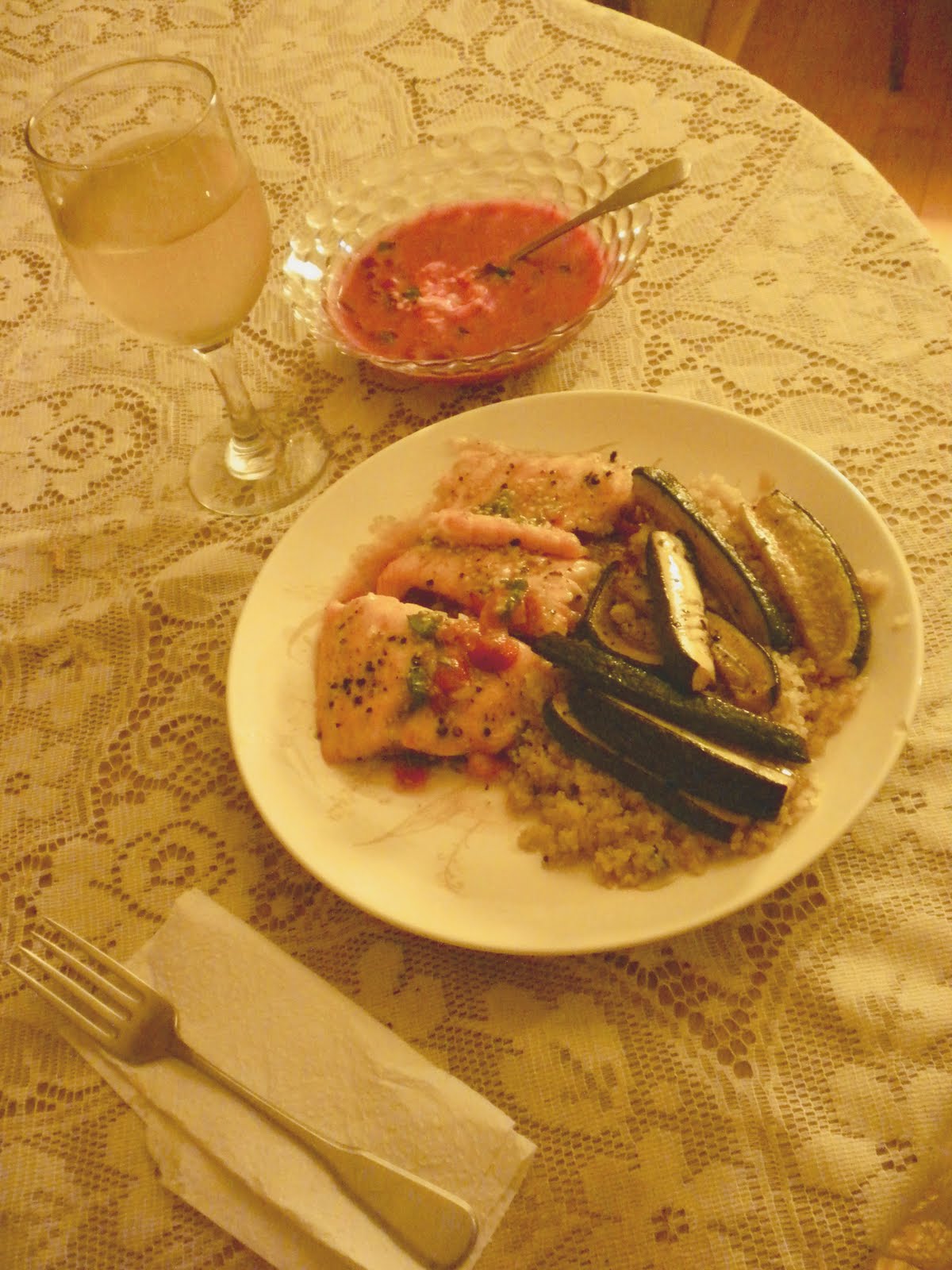
A recipe given to me by my grandmother, I made this seasonal salmon recipe the other night and served it with quinoa pilaf (a tasty and nutritious grain from South America), zucchini spears in a maple-soy marinade, and spicy sweet chilled beet soup.
Yields 4 servings


Sauce
4 cups diced, deseeded tomatoes (any size or variety)
¼-½ cup olive oil
2 tablespoons sherry wine vinegar
½ cup minced shallots
2 cloves minced garlic
2 tablespoons lemon zest
½ cup chopped fresh basil
optional: ¼ cup chopped fresh herbs (thyme, oregano, chives, etc.)
sea salt, black pepper, and cayenne pepper to taste

Salmon
four 6-8 oz. salmon filets
olive oil
sea salt & black pepper to taste
lemon wedges

1. Combine ingredients for the sauce in a medium, non-reactive bowl, three hours to two days ahead of time. Mix well, cover and put in the fridge to marinate.
2. Preheat the oven to broil.
3. Brush the salmon filets with olive oil, add salt and pepper to taste. Place filets skin side down (if using filets with skin) onto an oiled piece of aluminum foil on a baking sheet.
4. Place salmon in the broiler about 5-6 inches under heat. Broil for 7-8 minutes until salmon is firm to the touch and opaque pink in the middle.
5. Spoon a generous amount of the sauce onto individual dinner plates. Place salmon filet on top of sauce, spoon more sauce on top. Serve with lemon wedges


Baked Stuffed Zucchini with Beef, Broccoli & Tomatoes
My mom’s recipe, I made this dish for a Labor Day Weekend potluck. It transports well and tastes great hot or cold. A vegetarian version can be made by substituting spinach, garden vegetables, and/or soft cheese for the hamburger meat. To satisfy the carnivore, replace or augment the sliced tomatoes on top with fried bacon.
Yields 4 servings


2 large (10-12 inches) zucchini

Stuffing Mixture
2 tablespoons olive oil
1 medium onion, chopped
2 cloves garlic, minced
1½ cups chopped fresh seasonal vegetables: I used broccoli and diced cherry tomatoes
¾ lb. ground beef: I used all-natural Belted Galloway beef from Meadowview Farm on Darling Hill
2 tablespoons lemon juice
2 tablespoons fresh chopped parsley
sea salt & black pepper to taste
1 cup quinoa
2 cups water

shredded Vermont cheddar cheese
thinly sliced fresh tomato

1. Preheat the oven to 375 degrees F.
2. Halve zucchini lengthwise. Scoop out seeds to create 4 “zucchini boats”.
3. Poke several holes into the zucchini with a fork. Place onto an oiled baking sheet and bake in the oven for 25 minutes.
4. Heat olive oil on medium heat in a medium-sized saucepan.
5. Cook onions until soft, then add garlic. Sauté until garlic is aromatic.
6. Stir in ground beef, mixing well with the vegetables. Cook thoroughly until brown.
7. Add seasonal vegetables in order of the length of time they take to cook to tenderness: add broccoli just after the onions and before the garlic; add tomatoes after the hamburger has browned.
8. Boil the water in a separate medium saucepan. Stir in quinoa, lower heat to medium. Cook covered for around 15 minutes, until liquid is absorbed and quinoa is fluffy. Stir into stuffing mixture.
9. Fill the zucchini, mounding stuffing slightly above the edge of the “boat”. Top zucchini with cheddar cheese and bake for a further 20 minutes, adding sliced tomatoes on the top for the final 10 minutes.
10. Remove from oven. Sprinkle with fresh parsley and cool for 10 minutes.


Side Dishes

Quinoa Pilaf
Most boxes have easy directions on the side.
Yields 4 servings

2 tablespoons olive oil
½ cup minced onions
1 clove minced garlic
2 cups water or chicken broth
1 cup quinoa
¼ cup fresh chopped parsley
2 tablespoons lemon juice

1. Heat olive oil on medium low heat in a medium-sized saucepan.
2. Cook onions until soft, then add garlic. Sauté until garlic is aromatic.
3. Add water or broth, cover and turn up heat to high to bring water to a boil.
4. Stir in quinoa, lower heat to medium. Cook covered for around 15 minutes, until liquid is absorbed and quinoa is fluffy.
5. Stir in parsley and lemon juice, serve hot or cold.


Zucchini Spears in Maple-Soy Marinade
My own invention.
Yields 4 servings

Sauce
¼ cup pure Vermont maple syrup-what else?
¼ cup low sodium soy sauce
¼ cup olive oil
black pepper to taste

2 medium (8-10 inches) zucchini

1. Combine maple syrup, soy sauce, olive oil, and pepper.
2. Cut zucchini into 4-5 inch spears.
3. Marinate zucchini in sauce for 20 minutes or more.
4. Cook zucchini in your favorite manner: broiled, grilled, or sautéed until cooked through.


Spicy Sweet Chilled Beet Soup
My own invention.
Yields 4 servings

2 cups diced beets (any variety)
1 cup diced red potatoes
8 tablespoons butter
¼ cup pure Vermont Maple syrup
¼ teaspoon cayenne pepper, add more to taste
sea salt & black pepper to taste
4 cups milk
sour cream
¼ cup chopped fresh herbs (basil, oregano, thyme, chives, etc.)

1. Steam beets and potatoes until tender enough to separate with a fork. Mash well.
2. Add butter, maple syrup, cayenne, salt, pepper and milk. Blend well.
3. Chill until cold. Serve with a dollop of sour cream, sprinkle with fresh herbs.


Joe's Brook Farm


The Special
This week we are pleased to feature organically grown tomatoes and assorted seasonal vegetables from Joe’s Brook Farm of Barnet, Vermont. All this week, Chef Casey Graham will use Joe’s Brook Farm products in main dishes, appetizers, soups, and salads. Be sure to ask your server about tonight’s Farm to Table Special!

The Farm
Joe’s Brook Farm is an organic vegetable farm in Barnet, located south of St. Johnsbury in Vermont’s Northeast Kingdom. They are a CSA (Community Supported Agriculture), providing weekly shares of vegetables, eggs and specialty items to 10 local members and they attend weekly farmer’s markets in Lyndonville (Fridays from 3-7pm), St. Johnsbury (Saturdays from 9am-1pm), and Danville (Wednesday mornings). They also provide produce to several local fine restaurants.

www.joesbrookfarm.com


It is good to know and be friendly with your neighbors. The connections you make with the people in your community have a real impact on the quality of daily life, especially when you live in a sparsely populated area like the NEK (Northeast Kingdom). The most important connection you can make when you are trying to be a “localvore” – one who eats only or mostly food that is produced locally - is the one you make with your local farmer. So it is good to have neighbors like Mary Houde-Skovsted and her husband Eric of Joe’s Brook Farm, because they provide members of their community with beautiful, organic vegetables, and keep their land healthy, active, and undeveloped in the tradition of the small family farm. As it turns, out, I am technically a neighbor-once-removed of Mary and Eric, who attended Middlebury college with my real life next-door neighbor. It is a typical kind of connection in this NEK of the woods.

I am visiting Joe’s Brook Farm in Barnet, about 8 miles past St. Johnsbury on Route 5. It is a muggy July morning during this third week of uncharacteristically hot weather here in the Kingdom. At the famous red round barn in Barnet, I make a right on Joe’s Brook Road, pass Brook Hill Road and pull into to the 19th century farmhouse on the left. Across the street sits the barn, sagging back slightly from the road. Eventually the barn will become a farm stand with help from a historic restoration grant from the state. The land drops off sharply behind the barn to the fertile floodplain of Joe’s Brook.


I meet Mary at the farmhouse and we walk behind the barn to the rows of lush vegetables below, discussing our mutual friend and the small world we live in. Mary points out her portable greenhouse, which moves along a rail system that allows it to house cold weather crops like spinach until they can survive outdoors, then moves to shelter warmer weather crops like tomatoes. One of Mary’s neighbors and the former owner of the farm, Stewart Hoyt, stops by looking for plant starters. Stewart is a carpenter and artist, and created the beautiful statue of the man that overlooks Mary’s garden (could this be Joe of Joe’s Brook?). The main greenhouses where Mary grows her tomatoes are on a plot of land that includes the home, sugarhouse and garden of the late Airie Lindsay, one of the founders of the Northeast Organic Farming Association (NOFA). Airie’s daughter and son-in-law now lease the land to Mary and Eric and also donated their tractor and farm truck to the fledgling farmers. It's all about connections.


I am setting up the camera for our interview when Mary comments that these farm visits I’m doing must be starting to blur into each other. I have to admit that in certain ways, yes, they are. Whether they raise animals, vegetables, or make syrup there seem to be only a few reasons why people choose to be natural and organic farmers in northern Vermont: they love the area, they feel strongly about protecting the environment, and they are passionate about good, fresh food and want to share it with others. But how did they get to where they are now? That part of the story is always unique and interesting.

We interrupt this article for a brief Northeast Kingdom moment:
Mary and I are talking and walking through the garden when the frantic barking of her huge dog Maddy brings our attention to the large bull moose who has just arrived in the next field over.

Okay, now we can move on.

Mary is from Barnet and grew up about 2 miles away on a dairy farm, the eleventh of twelve siblings. She met Eric in college. The couple moved to the Northeast Kingdom in 2007 and bought their farm. This year is their first doing a CSA (Community Supported Agriculture), providing weekly shares of vegetables, eggs, and specialty items like maple syrup to 10 local members, and they attend weekly farmer’s markets in Lyndonville, St. Johnsbury, and Danville. Growing up, Mary did not want the life of a dairy farmer, but vegetables had their appeal. “I grew up down the road and my mom always had a big garden, and we always ate out of the garden,” she says. Her early exposure to homegrown food influenced her shopping habits in college and ultimately her views on our national food system and choice of career. “I think everyone should have the chance to buy fresh local food and see what it tastes like, because to me, that’s real food,” she explains.

Since purchasing the farm, Mary has devoted herself full time to the endeavor and has witnessed a surge in the demand for local, organic foods. She is excited to be a part of a community of farmers who are working together to promote the local foods movement. “There are a lot of opportunities for more education,” Mary says. “I think we all realize that we’re not in competition with each other, we’re in competition with Price Chopper and California, the bigger guys, and if we can all just be on the same page, and be friends, and share our techniques, then we can get much further standing together.” Mary is also appreciative of work that the state is doing to promote small vegetable farms. The Vermont NRCS (Natural Resource Conservation Service) is an organization that traditionally provides aid to dairy farms, and they recently began offering an opportunity for local vegetable growers to obtain free large greenhouses. The program stipulates that the greenhouses cannot have heat or electricity, but the structures alone will allow farmers to grow cold weather crops far later in the season.

Joe’s Brook Farm currently grows everything from spinach, broccoli and tomatoes to pak choi, fennel and ground cherries. They will soon offer strawberries, raspberries, and blueberries, and will have maple syrup in the spring. I ask Mary how she is eating her vegetables at the moment. “I like tomatoes raw, with a little balsamic vinegar and olive oil,” she says. “You can’t underestimate good olive oil because that adds a lot to any dish. I’ve been eating a lot of gazpacho in this heat.” Good idea. I drive away with plans to jump in Joe’s Brook, make gazpacho, and visit my nextdoor neighbor to tell her about the new connection I’ve made.

Sunday, July 25, 2010

Mountain Foot Farm


The Special
This week we are pleased to feature organically grown kohlrabi, French filet beans, lettuce, zucchini, summer squash and brown trout from Mountain Foot Farm of South Wheelock, Vermont. All this week, Chef Casey Graham will use Mountain Foot Farm products in main dishes, appetizers, soups, and salads. Be sure to ask your server about tonight’s Farm to Table Special!

The Farm
Mountain Foot Farm is an organic farm in South Wheelock, located just outside of Lyndonville in Vermont’s Northeast Kingdom. They have a CSA (Community Supported Agriculture), providing weekly shares of vegetables to around 10 local members and they attend weekly farmer’s markets in St. Johnsbury (Saturdays from 9am-1pm), and Danville (9am-1pm). They also provide produce to several local fine restaurants.

www.mtnfootfarm.net

Mountain Foot Farm

Do you know the Vermont Recycling Motto?

Use it up,
Wear it out,
Make do,
Or do without.

Curtis Sjolander of Mountain Foot Farm is familiar with the motto, and he credits much of his success as a small trout, vegetable and flower farmer in Vermont’s Northeast Kingdom to its principles of thrift and ingenuity. “I drive old cars,” he says, “and I have a small mortgage.” He plans to expand his brown trout production into three new tanks this year, which he will construct out of an old grain silo he was given. “Creative Answers to Interesting Questions” might be a good motto for Mountain Foot Farm.

Curt was born in Massachusetts but has lived in Vermont for most of his life. His parents moved to St. Johnsbury where they still live, and he attended high school at St. Johnsbury Academy. Curt obtained his degree in computer science in Troy, New York, where he met his wife Joan, who is a nurse. They built their house on South Wheelock Road in 1984 and began to make a real go at farming in 1989. They have been regulars at the Caledonia Farmer’s Markets in St. Johnsbury and Danville for over twenty years. During the few months of the year when there is not much to do on the farm besides feeding and processing the trout, Curt works part time as a freelance software engineer.

The Sjolanders own a total of about 30 acres of land in two parcels. One parcel in the town of Wheelock, about 10 acres, contains their home, attached greenhouse, barn with trout rearing tanks, maple sugarbush and woodlot. The other parcel, about 20 acres in the town of Lyndon, has the main gardens, hoop houses, storage sheds, pasture, softwoods and undeveloped land. A third parcel is on Curt’s parents' land in St. Johnsbury where there are garden plots.


Why trout farming? When they bought the property and built their house at the foot of Ide, Wheelock, and Stannard Mountains, the Sjolanders discovered that the land had a particularly good spring that produced more water than was needed by the house alone, and they could think of no better way to use the excess cold, clean water than to install gravity fed trout tanks. Why vegetables? Curt has learned that diversifying his production is a good safeguard against the inevitable small and large disasters that farmers face every season (lost crops, personal or financial difficulties, etc.), and he also likes to keep life interesting by learning to raise new, unusual crops. Why farming at all, for a person who could make a steady living as a freelance software engineer? “I like to be out and about,” Curt says simply. “Who wants to sit at a computer all of the time?”

While not certified organic, Mountain Foot Farm does follow organic principles. Curtis practices long distance rotation of crops on his three parcels of land, which keeps pest populations under control by interrupting their generational life cycles. Another organic practice: cats, a perfectly natural and effective method of pest control. Throughout the interview, barn cats wind around our legs and keep watch for rodents. Mountain Foot Farm's fish are kept healthy without the use of medications, which Curt achieves by keeping a low density of fish in each tank and feeding them only once a day to promote slow growth and optimal health. The trout thrive in gravity-fed tanks filled with fresh spring water, which ranges in temperature from 46-52 degrees Farenheit. They are around 10–12 inches long and about 3-4 years old when they are sold.


Last year, which was one of his best for the trout business, Curt sold between three and four thousand trout to local restaurants and still was not able to keep up with demand. Curt has watched interest in local foods increase during his years at the Caledonia farmers’ markets, and in particular there are more requests than ever from local chefs for his fish. Unfortunately, this year has not been a good one for his trout because of heavy mink predation on their tanks this winter. His tanks normally produce 200 fish a week, but this summer Curt has only 200 total fish to ration to his customers over the next few months. This is the type of annual farming disaster that is predictably unpredictable, and a good example of why the Sjolanders are so diversified in their farming.

One of the unusual vegetables that Curtis raises is kohlrabi, a leafy vegetable in the cabbage and broccoli family. He recites for me the regular spiel he gives to his farmer’s market customers on how to prepare it: “There are three ways you can do it. Peel it, cube it up or slice it up thin, and boil it. Or you can thin slice and stir-fry. Your other option is to thin slice it and eat it raw in a salad.” The trout his eats is prepared simply. Most days Joan breads the fish and throws into the frying pan, but on special occasions she likes to bread it lightly, stuff the cavity with herbs, sprinkle it with a bit of white wine, and bake it in the oven. At Mountain Foot Farm, a delicious answer to a tasty question.

Sunday, June 20, 2010

Local Foods

Dear Readers,

I hope you have been enjoying reading the Northeast Kingdom Farm to Table Blog. This project has been a wonderful opportunity for me to become more familiar with the local food scene. It is exciting to learn about so many good people working so hard to provide high quality, healthy food for their neighbors.

Here are links to all of the farms we’ve featured so far:
Pete’s Greens, Craftsbury VT
www.petesgreens.com
Chandler Pond Farm, South Wheelock VT
www.chandlerpondfarm.com
Deep Mountain Maple, West Glover VT
www.deepmountainmaple.com
Shuttleworth Farm, Westfield, VT
www.shuttleworthfarm.com

And to the Vermont Fresh Network, a program that links farms and restaurants across the state of Vermont: www.vermontfresh.net.

This week we are once again featuring meat from Shuttleworth Farm, and I’d like to take this opportunity to familiarize you more with the concept of “farm to table” or “local foods.” I’ve taken the following information selectively from the Wikipedia article on local foods. There are links at the end to some excellent online articles to read about the movement, as well as recommendations for books and movies to check out.
full article
“The Farm to Table, or Local Foods Movement is a collaborative effort to build more locally based, self-reliant food economies - one in which sustainable food production, processing, distribution, and consumption is integrated to enhance the economic, environmental and social health of a particular place” and is considered to be a part of the broader sustainability movement. It is part of the concept of local purchasing and local economies, a preference to buy locally produced goods and services. Those who prefer to eat locally grown/produced food sometimes call themselves locavores or localvores.

The concept is often related to the slogan "Think globally, act locally'', common in green politics. Those supporting development of a local food economy consider that since food is needed by everyone, everywhere, every day, a small change in the way it is produced and marketed will have a great effect on individual's health, the ecosystem and preservation of cultural diversity. Activists in the movement claim that shopping decisions favoring local food consumption directly affects the well-being of people, improve local economies and may be more ecologically sound.

Critics of the movement often say that local food tends to be more expensive to the consumer than food bought without regard to provenance and could never provide the variety currently available (such as having summer vegetables available in winter, or having kinds of food available which can not be locally produced due to soil, climate or labor conditions. The actual cost of local food versus non-local food is still being debated, since costs can vary depending on the region. Generally there is a consensus that local food can be more expensive, though community-supported agriculture (CSA) can make eating local food more affordable and accessible to the local community.

Local food proponents point out that the lower price of commodified food (which is sometimes called cheap food) is often due to a variety of governmental subsidies, including direct subsidies such as price supports, direct payments or tax breaks, and indirect approaches such as subsidies for trucking via road infrastructure investment, and often does not take into account the true cost of the product. As a result, organic and sustainably grown food will continue to cost more until policy changes are made. Some suggest that it is acceptable to favor local foods when available, rather than limit oneself to strictly local foods."

Well said, Wikipedia.

Thanks for reading, check back next week when we’ll be featuring Berry Creek Farm of Westfield!

Recommended Books
The Omnivore’s Dilemma by Michael Pollan’s
Animal, Vegetable, Mineral by Barbara Kingsolver

Recommended Movies:
The Future of Food
Food Inc.

Online Articles:
“Food That Travels Well.”
The New York Times, August 6, 2007
"A Locally Grown Diet With Fuss but No Muss." The New York Times. July 22, 2008
“The Lure of the 100-Mile Diet.” Time Magazine. Sunday June 11, 2006.
“Eating Better Than Organic.” Tim Magazine. March 2, 2007.
“The Cost of Eating Green.” MSN Money.

Saturday, May 29, 2010

Chandler Pond Farm


This week we are pleased to feature radishes, beet greens, lettuce, chicken, and eggs from Chandler Pond Farm of South Wheelock, Vermont. Chef Casey Graham will use locally-grown organic Chandler Pond Farm products in main dishes, appetizers, soups, and salads.


On a glorious Wednesday morning in late May, Chandler Pond Farm in South Wheelock is gearing up for what looks to be a great summer season. Orderly rows of radishes and assorted greens bask in the spring sunshine, and Rob and Tamara Martin direct their summer interns in a variety of projects. It’s their third year as organic farmers in the Northeast Kingdom, and they have big plans in the works - new blueberry and asparagus patches overlook the pond, the farm stand is almost ready, and expectant Devon cows are due to calve any day.

The Martins lease 200 acres in South Wheelock and have about five acres in crop rotation, producing tomatoes, strawberries, sweet corn and a variety of other vegetables. They also raise one thousand chickens for meat each year, have a small flock of laying hens, several pigs, and a small herd of Devon and Jersey cows from which they get raw milk and meat. They plan to make maple syrup in the spring and they host visitors for oxen rides and tours of the farm.

It’s a huge amount of work for the Martins, who have three children under five years old, even with the help of their four farm interns and a retired neighbor, but there is no doubt it is a labor of love. “With all the things we do, Rob says sometimes he feels like the conductor of an orchestra,” Tamara says. They are certainly making beautiful music. The farm is orderly, productive and serene. A walk up the road to the property’s second farmhouse reveals a lovely view of Chandler Pond, where the family and their helpers enjoy canoeing, fishing and swimming. Their days are filled with hard work and the enjoyment of good food, family, and the natural splendor of the Northeast Kingdom.

Rob Martin is a fifth generation Vermont farmer from Bradford, Vermont. An avid sailor, Rob met Tamara in her hometown of Cordova, Alaska, famous for its salmon fishing, where he was stationed as a member of the Coast Guard. After a wonderful year of sailing around the Bahamas together and four years working on an organic farm in southern Vermont, Rob and Tamara settled their family in the Northeast Kingdom and began making their dream of building an organic family farm together a reality.

Tamara says that growing up she knew a lot about salmon and not a thing about farming, but she has taken to it like a fish to water. She is excited about the future of small-scale organic agriculture and local food systems, and she sees great potential in Vermont for the production of staple crops as well as specialty food items. As a mother of three, the well-being of her children drives her commitment to farming. “The more I learn about the food system,” she says, “the more I’m convinced that small-scale agriculture is necessary. A big reason we decided to farm and do so in a sustainable and chemical-free way was for the health of our children. I want my kids to be able to eat the dirt – and they do!”

They love visitors at Chandler Pond Farm and host several public events throughout the year, including an Open Farm evening on Wednesday June 16th from 3-6pm, a Farm Play Group for kids of all ages on the first and third Thursdays of the month from 10am to noon during June through August, and a Harvest Potluck on Saturday, October 9th at 3pm. Starting this June, CSA shareholders will be able to pick up their shares from the farm stand for around $18 a week, $345 for the entire season. The Chandler Pond Farm website, www.chandlerpondfarm.com, keeps customers updated on what’s happening at the farm and has several links to organizations that promote sustainable farming practices.

This spring, the Martins are enjoying eating their greens and radishes in salads – “It’s salad season!” beams Tamara – and also in some unconventional ways: cut into slices, Tamara lightly fries or roasts radishes in peanut or olive oil and sprinkles them with soy sauce and toasted sesame seeds. Mmm, simple, fresh, delicious. That’s how to eat like a local.