Showing posts with label farm to table. Show all posts

Sunday, September 5, 2010

True Love and Homegrown Tomatoes

Homegrown tomatoes, homegrown tomatoes,
What'd life be without homegrown tomatoes?
Only two things that money can't buy-
That's true love and homegrown tomatoes.

-Guy Clark, American songwriter

This week the Northeast Kingdom Farm to Table Project is pleased to once again feature Joe’s Brook Farm of Barnet, Vermont, who will be providing Juniper’s Restaurant with fresh tomatoes and assorted seasonal vegetables.

It is the second week of September, and my garden continues to produce mind-boggling amounts of zucchini. Luckily, the tomatoes are catching up, and their glowing red sweet acidity is a perfect visual and gustatory (word of the day: relating to the sense of taste) complement to cool, green zucchini.

The recipes in this week’s post are inspired by the harvest of my garden, particularly by the sweet cherry tomatoes coming in by the dozen. I’ve included some tomato laden main dishes as well as side-dishes of other seasonal vegetables.

Here's to True Love and Homegrown Tomatoes!

Main Dishes

Salmon Provençal
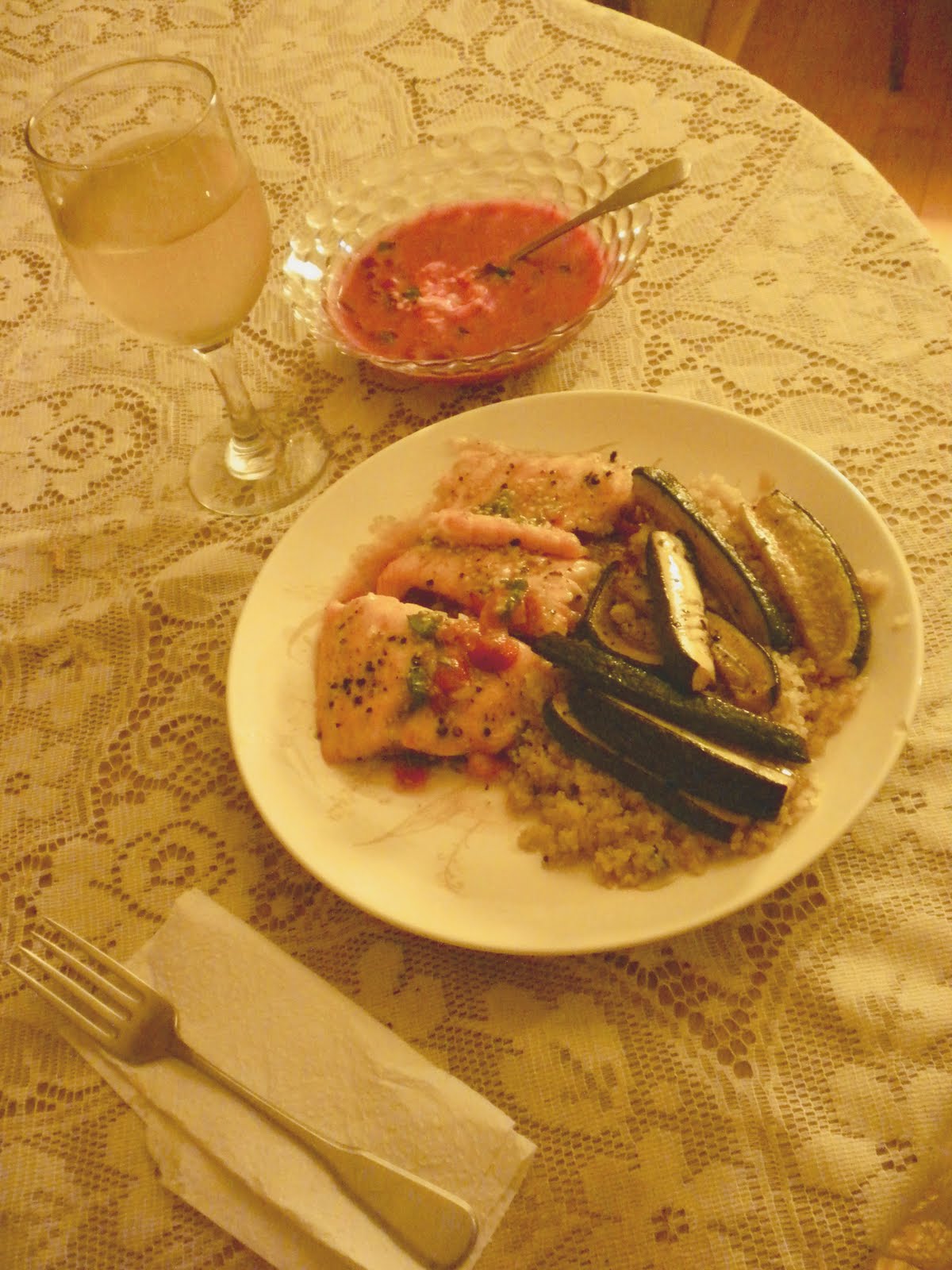
A recipe given to me by my grandmother, I made this seasonal salmon recipe the other night and served it with quinoa pilaf (a tasty and nutritious grain from South America), zucchini spears in a maple-soy marinade, and spicy sweet chilled beet soup.
Yields 4 servings

Sauce
4 cups diced, deseeded tomatoes (any size or variety)
¼-½ cup olive oil
2 tablespoons sherry wine vinegar
½ cup minced shallots
2 cloves minced garlic
2 tablespoons lemon zest
½ cup chopped fresh basil
optional: ¼ cup chopped fresh herbs (thyme, oregano, chives, etc.)
sea salt, black pepper, and cayenne pepper to taste

Salmon
four 6-8 oz. salmon filets
olive oil
sea salt & black pepper to taste
lemon wedges

1. Combine ingredients for the sauce in a medium, non-reactive bowl, three hours to two days ahead of time. Mix well, cover and put in the fridge to marinate.
2. Preheat the oven to broil.
3. Brush the salmon filets with olive oil, add salt and pepper to taste. Place filets skin side down (if using filets with skin) onto an oiled piece of aluminum foil on a baking sheet.
4. Place salmon in the broiler about 5-6 inches under heat. Broil for 7-8 minutes until salmon is firm to the touch and opaque pink in the middle.
5. Spoon a generous amount of the sauce onto individual dinner plates. Place salmon filet on top of sauce, spoon more sauce on top. Serve with lemon wedges


Baked Stuffed Zucchini with Beef, Broccoli & Tomatoes
My mom’s recipe, I made this dish for a Labor Day Weekend potluck. It transports well and tastes great hot or cold. A vegetarian version can be made by substituting spinach, garden vegetables, and/or soft cheese for the hamburger meat. To satisfy the carnivore, replace or augment the sliced tomatoes on top with fried bacon.
Yields 4 servings


2 large (10-12 inches) zucchini

Stuffing Mixture
2 tablespoons olive oil
1 medium onion, chopped
2 cloves garlic, minced
1½ cups chopped fresh seasonal vegetables: I used broccoli and diced cherry tomatoes
¾ lb. ground beef: I used all-natural Belted Galloway beef from Meadowview Farm on Darling Hill
2 tablespoons lemon juice
2 tablespoons fresh chopped parsley
sea salt & black pepper to taste
1 cup quinoa
2 cups water

shredded Vermont cheddar cheese
thinly sliced fresh tomato

1. Preheat the oven to 375 degrees F.
2. Halve zucchini lengthwise. Scoop out seeds to create 4 “zucchini boats”.
3. Poke several holes into the zucchini with a fork. Place onto an oiled baking sheet and bake in the oven for 25 minutes.
4. Heat olive oil on medium heat in a medium-sized saucepan.
5. Cook onions until soft, then add garlic. Sauté until garlic is aromatic.
6. Stir in ground beef, mixing well with the vegetables. Cook thoroughly until brown.
7. Add seasonal vegetables in order of the length of time they take to cook to tenderness: add broccoli just after the onions and before the garlic; add tomatoes after the hamburger has browned.
8. Boil the water in a separate medium saucepan. Stir in quinoa, lower heat to medium. Cook covered for around 15 minutes, until liquid is absorbed and quinoa is fluffy. Stir into stuffing mixture.
9. Fill the zucchini, mounding stuffing slightly above the edge of the “boat”. Top zucchini with cheddar cheese and bake for a further 20 minutes, adding sliced tomatoes on the top for the final 10 minutes.
10. Remove from oven. Sprinkle with fresh parsley and cool for 10 minutes.


Side Dishes

Quinoa Pilaf
Most boxes have easy directions on the side.
Yields 4 servings

2 tablespoons olive oil
½ cup minced onions
1 clove minced garlic
2 cups water or chicken broth
1 cup quinoa
¼ cup fresh chopped parsley
2 tablespoons lemon juice

1. Heat olive oil on medium low heat in a medium-sized saucepan.
2. Cook onions until soft, then add garlic. Sauté until garlic is aromatic.
3. Add water or broth, cover and turn up heat to high to bring water to a boil.
4. Stir in quinoa, lower heat to medium. Cook covered for around 15 minutes, until liquid is absorbed and quinoa is fluffy.
5. Stir in parsley and lemon juice, serve hot or cold.


Zucchini Spears in Maple-Soy Marinade
My own invention.
Yields 4 servings

Sauce
¼ cup pure Vermont maple syrup-what else?
¼ cup low sodium soy sauce
¼ cup olive oil
black pepper to taste

2 medium (8-10 inches) zucchini

1. Combine maple syrup, soy sauce, olive oil, and pepper.
2. Cut zucchini into 4-5 inch spears.
3. Marinate zucchini in sauce for 20 minutes or more.
4. Cook zucchini in your favorite manner: broiled, grilled, or sautéed until cooked through.


Spicy Sweet Chilled Beet Soup
My own invention.
Yields 4 servings

2 cups diced beets (any variety)
1 cup diced red potatoes
8 tablespoons butter
¼ cup pure Vermont Maple syrup
¼ teaspoon cayenne pepper, add more to taste
sea salt & black pepper to taste
4 cups milk
sour cream
¼ cup chopped fresh herbs (basil, oregano, thyme, chives, etc.)

1. Steam beets and potatoes until tender enough to separate with a fork. Mash well.
2. Add butter, maple syrup, cayenne, salt, pepper and milk. Blend well.
3. Chill until cold. Serve with a dollop of sour cream, sprinkle with fresh herbs.


Joe's Brook Farm


The Special
This week we are pleased to feature organically grown tomatoes and assorted seasonal vegetables from Joe’s Brook Farm of Barnet, Vermont. All this week, Chef Casey Graham will use Joe’s Brook Farm products in main dishes, appetizers, soups, and salads. Be sure to ask your server about tonight’s Farm to Table Special!

The Farm
Joe’s Brook Farm is an organic vegetable farm in Barnet, located south of St. Johnsbury in Vermont’s Northeast Kingdom. They are a CSA (Community Supported Agriculture), providing weekly shares of vegetables, eggs and specialty items to 10 local members and they attend weekly farmer’s markets in Lyndonville (Fridays from 3-7pm), St. Johnsbury (Saturdays from 9am-1pm), and Danville (Wednesday mornings). They also provide produce to several local fine restaurants.

www.joesbrookfarm.com


It is good to know and be friendly with your neighbors. The connections you make with the people in your community have a real impact on the quality of daily life, especially when you live in a sparsely populated area like the NEK (Northeast Kingdom). The most important connection you can make when you are trying to be a “localvore” – one who eats only or mostly food that is produced locally - is the one you make with your local farmer. So it is good to have neighbors like Mary Houde-Skovsted and her husband Eric of Joe’s Brook Farm, because they provide members of their community with beautiful, organic vegetables, and keep their land healthy, active, and undeveloped in the tradition of the small family farm. As it turns, out, I am technically a neighbor-once-removed of Mary and Eric, who attended Middlebury college with my real life next-door neighbor. It is a typical kind of connection in this NEK of the woods.

I am visiting Joe’s Brook Farm in Barnet, about 8 miles past St. Johnsbury on Route 5. It is a muggy July morning during this third week of uncharacteristically hot weather here in the Kingdom. At the famous red round barn in Barnet, I make a right on Joe’s Brook Road, pass Brook Hill Road and pull into to the 19th century farmhouse on the left. Across the street sits the barn, sagging back slightly from the road. Eventually the barn will become a farm stand with help from a historic restoration grant from the state. The land drops off sharply behind the barn to the fertile floodplain of Joe’s Brook.


I meet Mary at the farmhouse and we walk behind the barn to the rows of lush vegetables below, discussing our mutual friend and the small world we live in. Mary points out her portable greenhouse, which moves along a rail system that allows it to house cold weather crops like spinach until they can survive outdoors, then moves to shelter warmer weather crops like tomatoes. One of Mary’s neighbors and the former owner of the farm, Stewart Hoyt, stops by looking for plant starters. Stewart is a carpenter and artist, and created the beautiful statue of the man that overlooks Mary’s garden (could this be Joe of Joe’s Brook?). The main greenhouses where Mary grows her tomatoes are on a plot of land that includes the home, sugarhouse and garden of the late Airie Lindsay, one of the founders of the Northeast Organic Farming Association (NOFA). Airie’s daughter and son-in-law now lease the land to Mary and Eric and also donated their tractor and farm truck to the fledgling farmers. It's all about connections.


I am setting up the camera for our interview when Mary comments that these farm visits I’m doing must be starting to blur into each other. I have to admit that in certain ways, yes, they are. Whether they raise animals, vegetables, or make syrup there seem to be only a few reasons why people choose to be natural and organic farmers in northern Vermont: they love the area, they feel strongly about protecting the environment, and they are passionate about good, fresh food and want to share it with others. But how did they get to where they are now? That part of the story is always unique and interesting.

We interrupt this article for a brief Northeast Kingdom moment:
Mary and I are talking and walking through the garden when the frantic barking of her huge dog Maddy brings our attention to the large bull moose who has just arrived in the next field over.

Okay, now we can move on.

Mary is from Barnet and grew up about 2 miles away on a dairy farm, the eleventh of twelve siblings. She met Eric in college. The couple moved to the Northeast Kingdom in 2007 and bought their farm. This year is their first doing a CSA (Community Supported Agriculture), providing weekly shares of vegetables, eggs, and specialty items like maple syrup to 10 local members, and they attend weekly farmer’s markets in Lyndonville, St. Johnsbury, and Danville. Growing up, Mary did not want the life of a dairy farmer, but vegetables had their appeal. “I grew up down the road and my mom always had a big garden, and we always ate out of the garden,” she says. Her early exposure to homegrown food influenced her shopping habits in college and ultimately her views on our national food system and choice of career. “I think everyone should have the chance to buy fresh local food and see what it tastes like, because to me, that’s real food,” she explains.

Since purchasing the farm, Mary has devoted herself full time to the endeavor and has witnessed a surge in the demand for local, organic foods. She is excited to be a part of a community of farmers who are working together to promote the local foods movement. “There are a lot of opportunities for more education,” Mary says. “I think we all realize that we’re not in competition with each other, we’re in competition with Price Chopper and California, the bigger guys, and if we can all just be on the same page, and be friends, and share our techniques, then we can get much further standing together.” Mary is also appreciative of work that the state is doing to promote small vegetable farms. The Vermont NRCS (Natural Resource Conservation Service) is an organization that traditionally provides aid to dairy farms, and they recently began offering an opportunity for local vegetable growers to obtain free large greenhouses. The program stipulates that the greenhouses cannot have heat or electricity, but the structures alone will allow farmers to grow cold weather crops far later in the season.

Joe’s Brook Farm currently grows everything from spinach, broccoli and tomatoes to pak choi, fennel and ground cherries. They will soon offer strawberries, raspberries, and blueberries, and will have maple syrup in the spring. I ask Mary how she is eating her vegetables at the moment. “I like tomatoes raw, with a little balsamic vinegar and olive oil,” she says. “You can’t underestimate good olive oil because that adds a lot to any dish. I’ve been eating a lot of gazpacho in this heat.” Good idea. I drive away with plans to jump in Joe’s Brook, make gazpacho, and visit my nextdoor neighbor to tell her about the new connection I’ve made.

Sunday, August 29, 2010

Shuttleworth Farm

The Special
This week we are pleased to feature country style ribs, bacon, and lamb from Shuttleworth Farm of Westfield, Vermont. All this week, Chef Casey Graham will use naturally-raised Shuttleworth Farm meats in main dishes, appetizers, soups, and salads.

The Farm

Shuttleworth Farm is a family owned and operated farm located in the town of Westfield in the Northeast Kingdom of Vermont. Their sheep, pigs, and poultry are raised on the lush pastures that grow in the shadow of Jay Peak and lie along the banks of the Missisquoi River. Most of the meat from Shuttleworth Farm is sold within two hundred miles of the farm to individual customers as well as fine restaurants and natural food stores.


Shuttleworth Farm

In the green meadows of Westfield at the foot of Jay Peak, a flock of Shuttleworth Farm sheep graze contentedly as clouds engulf the moutain above. The flock is guarded by three border collies and two Great Pyrenées who keep the lambs and ewes from straying too near the banks of the Missiquoi River. This graceful valley is home to Kelli Fogg and Todd Shuttleworth and their daughter Isla, along with a few other small farms and country homes. Shuttleworth Farm is one of the biggest lamb producers in the state of Vermont and part of the growing local foods movement. Most of their lamb, pork, and poultry products are sold within two hundred miles of their property.

I am visiting Kelli and Todd at their farm on a cool morning in June. Isla, their sixteen month old, shows me around the barn, fearlessly toddling up to the dogs and sheep. Like her parents, she seems a born farmer. Todd Shuttleworth has loved family farming since spending his childhood summers on the original Shuttleworth Farm in Canaan, New Hampshire, where his grandparents raised dairy cows and vegetables. “A little bit of nostalgia helps you get involved. It can also help you keep going,” he says.

Todd studied farming at the University of Maryland. After graduation, he moved to the Northeast Kingdom to try his hand at running the family farm. It was in Vermont in 2003 that Todd met Kelli, his real estate agent and a former marketing major at Alfred University. Their shared passion for family farming and naturally raised foods led them to purchase a small flock of sheep and the former dairy farm in Westfield. This new generation of Shuttleworth Farm is a wonderful example of how a combination of responsible farming practices, favorable market trends and modern advertising strategies can support and sustain a small family farm. The Shuttleworths currently have 150-250 ewes, produce up to three hundred lambs a year, and have nine sows.

Nostalgic it may be, but this old-fashioned, low-tech approach to farming in many ways works better and is cheaper, healthier, and more environmentally sustainable than industrialized agriculture. The Shuttleworths have successfully adopted many traditional practices on their farm. They keep their pigs in the Swedish manner, with lots of clean deep straw for bedding and a separate area for their manure. “Pigs are very clean animals, if you give them the choice to be,” Todd observes. His work with the dogs is both nostalgic and effective. “I like to joke that the dogs saved our marriage.” He smiles. “Before we got them it would take us hours to round the sheep up.”

The Shuttleworths are excited about the local food movement and the surge of interest in organic and naturally produced food, though they are realistic about its challenges. “It’s tough. It’s tough for us to get the attention of lawmakers. The dairy industry gets plenty of low interest loans and subsidies,“ Todd says. “Getting a bank to believe in you and your business plan, that’s tough. But I think that as the movement grows, and more people are successful, it’ll get better.”

Another challenge lies in educating consumers about the cost of producing healthy food versus the cost of producing cheap food. Though local and natural foods will often be more expensive, consumers should consider that they are also purchasing reassuring knowledge of where their food is coming from and how it is produced. The cost of producing of cheap foods is more hidden, funded by government subsidies and, ultimately, taxpayers. “I think that consumers can provide some of the most powerful oversight, environmentally and otherwise,” says Todd. “When you have to live in the community where you sell your food, if you were raising a poor product you’d have a bad reputation quick. But when your food comes from God knows where, it’s like this invisible curtain that everything is hidden behind. There’s no real accountability, there’s no liability.”

The purchase of Shuttleworth Farm meats and other locally produced natural foods contributes not only to the growth of strong communities and a safer food system, but also to a healthier environment. “You don’t want to create problems,” Todd says. “We accept responsibility for all of the food we’re producing, everything. All that grain for the animals, all the manure from the animals, that gets handled responsibly.” Their sheep are mostly grass fed, which reduces the use of the fossil fuels it takes to grow and ship grain, and Todd believes the meat is the better for it. “Keeping those animals healthy, and they grow quick on a low or no grain diet, produces a leaner meat, so it’s not greasy,” he says. “You don’t need the mint sauce. It’s very tender.”
.
So of course, one of Todd’s favorite things about sheep farming is the opportunity for quality control. “I love it when a package breaks open and we have to eat it ourselves,” he grins. “I like everything grilled.” Kelli prefers roasting; she says that one of the family’s favorite meals is a boneless rolled lamb shoulder with Montreal steak seasoning, slow roasted in the oven.

The Shuttleworths have a wonderful website and farm blog at www.shuttleworthfarm.com. You can visit their website for information on ordering their products and to learn more about the family and their farming philosophy.


Shuttleworth Farm Mission Statement

People speak about sustainable agriculture as an ideal goal, but at Shuttleworth Farm, we think that sustainability is the least we can do. We are not about maintaining, we are about improving:

* Improving our soils with carefully planned rotations of sheep, laying hens, broilers, turkeys, pigs and hay that perfectly complement the natural growth cycle of our native cool season perennial grasses.
* Improving the health of our animals. Fresh air, sunshine, clean water, and lush green grass benefit all types of livestock, yet so much of modern agriculture denies animals these basic necessities. We let our animals eat and behave as nature intended them to.
* Improving the health of our consumers. Pasture-raised meats are much lower in fat, higher in heart healthy Omega-3 fatty acids and Conjugated Linoleic Acids (CLA's), and excellent sources of Vitamins A, B3, B6, B12, D and E (Jo Robinson, Eat Wild, 2006)
* Improving the health of our community. The average morsel of food in this country travels more than fifteen-hundred miles before it is consumed. (Pollan, Michael. The Omnivore's Dilemma. New York: The Penguin Press, 2006. 239p). We service our local markets. The vast majority of our meats are consumed within two hundred miles of our farm. This permits us to offer quicker time to market, reduced handling charges and huge reduction of the use of fossil fuels.

Sunday, July 25, 2010

Mountain Foot Farm


The Special
This week we are pleased to feature organically grown kohlrabi, French filet beans, lettuce, zucchini, summer squash and brown trout from Mountain Foot Farm of South Wheelock, Vermont. All this week, Chef Casey Graham will use Mountain Foot Farm products in main dishes, appetizers, soups, and salads. Be sure to ask your server about tonight’s Farm to Table Special!

The Farm
Mountain Foot Farm is an organic farm in South Wheelock, located just outside of Lyndonville in Vermont’s Northeast Kingdom. They have a CSA (Community Supported Agriculture), providing weekly shares of vegetables to around 10 local members and they attend weekly farmer’s markets in St. Johnsbury (Saturdays from 9am-1pm), and Danville (9am-1pm). They also provide produce to several local fine restaurants.

www.mtnfootfarm.net

Mountain Foot Farm

Do you know the Vermont Recycling Motto?

Use it up,
Wear it out,
Make do,
Or do without.

Curtis Sjolander of Mountain Foot Farm is familiar with the motto, and he credits much of his success as a small trout, vegetable and flower farmer in Vermont’s Northeast Kingdom to its principles of thrift and ingenuity. “I drive old cars,” he says, “and I have a small mortgage.” He plans to expand his brown trout production into three new tanks this year, which he will construct out of an old grain silo he was given. “Creative Answers to Interesting Questions” might be a good motto for Mountain Foot Farm.

Curt was born in Massachusetts but has lived in Vermont for most of his life. His parents moved to St. Johnsbury where they still live, and he attended high school at St. Johnsbury Academy. Curt obtained his degree in computer science in Troy, New York, where he met his wife Joan, who is a nurse. They built their house on South Wheelock Road in 1984 and began to make a real go at farming in 1989. They have been regulars at the Caledonia Farmer’s Markets in St. Johnsbury and Danville for over twenty years. During the few months of the year when there is not much to do on the farm besides feeding and processing the trout, Curt works part time as a freelance software engineer.

The Sjolanders own a total of about 30 acres of land in two parcels. One parcel in the town of Wheelock, about 10 acres, contains their home, attached greenhouse, barn with trout rearing tanks, maple sugarbush and woodlot. The other parcel, about 20 acres in the town of Lyndon, has the main gardens, hoop houses, storage sheds, pasture, softwoods and undeveloped land. A third parcel is on Curt’s parents' land in St. Johnsbury where there are garden plots.


Why trout farming? When they bought the property and built their house at the foot of Ide, Wheelock, and Stannard Mountains, the Sjolanders discovered that the land had a particularly good spring that produced more water than was needed by the house alone, and they could think of no better way to use the excess cold, clean water than to install gravity fed trout tanks. Why vegetables? Curt has learned that diversifying his production is a good safeguard against the inevitable small and large disasters that farmers face every season (lost crops, personal or financial difficulties, etc.), and he also likes to keep life interesting by learning to raise new, unusual crops. Why farming at all, for a person who could make a steady living as a freelance software engineer? “I like to be out and about,” Curt says simply. “Who wants to sit at a computer all of the time?”

While not certified organic, Mountain Foot Farm does follow organic principles. Curtis practices long distance rotation of crops on his three parcels of land, which keeps pest populations under control by interrupting their generational life cycles. Another organic practice: cats, a perfectly natural and effective method of pest control. Throughout the interview, barn cats wind around our legs and keep watch for rodents. Mountain Foot Farm's fish are kept healthy without the use of medications, which Curt achieves by keeping a low density of fish in each tank and feeding them only once a day to promote slow growth and optimal health. The trout thrive in gravity-fed tanks filled with fresh spring water, which ranges in temperature from 46-52 degrees Farenheit. They are around 10–12 inches long and about 3-4 years old when they are sold.


Last year, which was one of his best for the trout business, Curt sold between three and four thousand trout to local restaurants and still was not able to keep up with demand. Curt has watched interest in local foods increase during his years at the Caledonia farmers’ markets, and in particular there are more requests than ever from local chefs for his fish. Unfortunately, this year has not been a good one for his trout because of heavy mink predation on their tanks this winter. His tanks normally produce 200 fish a week, but this summer Curt has only 200 total fish to ration to his customers over the next few months. This is the type of annual farming disaster that is predictably unpredictable, and a good example of why the Sjolanders are so diversified in their farming.

One of the unusual vegetables that Curtis raises is kohlrabi, a leafy vegetable in the cabbage and broccoli family. He recites for me the regular spiel he gives to his farmer’s market customers on how to prepare it: “There are three ways you can do it. Peel it, cube it up or slice it up thin, and boil it. Or you can thin slice and stir-fry. Your other option is to thin slice it and eat it raw in a salad.” The trout his eats is prepared simply. Most days Joan breads the fish and throws into the frying pan, but on special occasions she likes to bread it lightly, stuff the cavity with herbs, sprinkle it with a bit of white wine, and bake it in the oven. At Mountain Foot Farm, a delicious answer to a tasty question.

Sunday, June 20, 2010

Local Foods

Dear Readers,

I hope you have been enjoying reading the Northeast Kingdom Farm to Table Blog. This project has been a wonderful opportunity for me to become more familiar with the local food scene. It is exciting to learn about so many good people working so hard to provide high quality, healthy food for their neighbors.

Here are links to all of the farms we’ve featured so far:
Pete’s Greens, Craftsbury VT
www.petesgreens.com
Chandler Pond Farm, South Wheelock VT
www.chandlerpondfarm.com
Deep Mountain Maple, West Glover VT
www.deepmountainmaple.com
Shuttleworth Farm, Westfield, VT
www.shuttleworthfarm.com

And to the Vermont Fresh Network, a program that links farms and restaurants across the state of Vermont: www.vermontfresh.net.

This week we are once again featuring meat from Shuttleworth Farm, and I’d like to take this opportunity to familiarize you more with the concept of “farm to table” or “local foods.” I’ve taken the following information selectively from the Wikipedia article on local foods. There are links at the end to some excellent online articles to read about the movement, as well as recommendations for books and movies to check out.
full article
“The Farm to Table, or Local Foods Movement is a collaborative effort to build more locally based, self-reliant food economies - one in which sustainable food production, processing, distribution, and consumption is integrated to enhance the economic, environmental and social health of a particular place” and is considered to be a part of the broader sustainability movement. It is part of the concept of local purchasing and local economies, a preference to buy locally produced goods and services. Those who prefer to eat locally grown/produced food sometimes call themselves locavores or localvores.

The concept is often related to the slogan "Think globally, act locally'', common in green politics. Those supporting development of a local food economy consider that since food is needed by everyone, everywhere, every day, a small change in the way it is produced and marketed will have a great effect on individual's health, the ecosystem and preservation of cultural diversity. Activists in the movement claim that shopping decisions favoring local food consumption directly affects the well-being of people, improve local economies and may be more ecologically sound.

Critics of the movement often say that local food tends to be more expensive to the consumer than food bought without regard to provenance and could never provide the variety currently available (such as having summer vegetables available in winter, or having kinds of food available which can not be locally produced due to soil, climate or labor conditions. The actual cost of local food versus non-local food is still being debated, since costs can vary depending on the region. Generally there is a consensus that local food can be more expensive, though community-supported agriculture (CSA) can make eating local food more affordable and accessible to the local community.

Local food proponents point out that the lower price of commodified food (which is sometimes called cheap food) is often due to a variety of governmental subsidies, including direct subsidies such as price supports, direct payments or tax breaks, and indirect approaches such as subsidies for trucking via road infrastructure investment, and often does not take into account the true cost of the product. As a result, organic and sustainably grown food will continue to cost more until policy changes are made. Some suggest that it is acceptable to favor local foods when available, rather than limit oneself to strictly local foods."

Well said, Wikipedia.

Thanks for reading, check back next week when we’ll be featuring Berry Creek Farm of Westfield!

Recommended Books
The Omnivore’s Dilemma by Michael Pollan’s
Animal, Vegetable, Mineral by Barbara Kingsolver

Recommended Movies:
The Future of Food
Food Inc.

Online Articles:
“Food That Travels Well.”
The New York Times, August 6, 2007
"A Locally Grown Diet With Fuss but No Muss." The New York Times. July 22, 2008
“The Lure of the 100-Mile Diet.” Time Magazine. Sunday June 11, 2006.
“Eating Better Than Organic.” Tim Magazine. March 2, 2007.
“The Cost of Eating Green.” MSN Money.