Sunday, October 3, 2010

The Cellars at Jasper Hill

The Special
This week we are pleased to feature Vermont artisan cheeses from the Cellars at Jasper Hill of Greensboro, Vermont as well as vegetables from Joe's Brook Farm of Barnet. All this week, Chef Casey Graham will use products from the Cellars at Jasper Hill and Joe's Brook Farm in main dishes, appetizers, soups, and salads. Be sure to ask your server about tonight’s Farm to Table Special!

The Farm
The Cellars at Jasper Hill is a 22,000 square foot, seven vault system of cheese aging caves located in Greensboro, Vermont. The Cellars were constructed for the purpose of providing affinage, or aging expertise, as well as distribution opportunities for local cheesemakers so that they may access the burgeoning market for artisan cheese nationwide. Artisan cheeses from the Cellars at Jasper Hill can be found locally and nationally in farm stands, natural and gourmet food stores, and fine restaurants.

The Cellars at Jasper Hill

Vermont’s Northeast Kingdom is currently engaged in a delicate economic balancing act. Land rich but cash poor, as a region and as a state we face critical decisions about which we value more. How can we build strong local economies while continuing to preserve and protect our natural environment? The political and geographical landscape of northeastern Vermont has been shaped by the dairy farming industry for decades, but a drop in commodity milk prices in the 1990s and the highly competitive organic milk industry have threatened dairy farming's long-term viability.

Enter the Cellars at Jasper Hill, a new 22,000 square foot complex of cheese aging caves on Jasper Hill Farm in Greensboro, Vermont. The Cellars are a partnership of several northeastern cheese producers who are using the infrastructure of the caves, Jasper Hill's existing national distribution system, the technical expertise of world-renowned artisan cheese makers and Vermont’s landscape of dairy farms to create a vibrant and profitable artisan cheese industry. In an article he wrote for the Diner Journal, a Brooklyn-based culinary magazine, Jasper Hill Farm owner Mateo Kehler writes, “We are building a local economy that is an expression of the landscape."


After getting enjoyably lost for a bit in Greensboro’s labyrinth of dirt roads and fall foliage-splashed pastures, I find myself only slightly late for my interview at the Cellars. My host is Zoe Brickley, the Cellars’ primary account manager and event planner. Zoe is a graduate of the French Culinary Institute of NYC and has a B.A. in philosophy. These dual focuses fit neatly into her work at the Cellars, where the prevailing philosophy is that a commitment to a place and its people can bring about the successful reinvention of its agricultural economy.

The Cellars at Jasper Hill is the brainchild of brothers Andrew and Mateo Kehler, along with a community of like-minded farmers and cheese makers looking to join forces to promote their products. The Kehlers, longtime summer residents of Caspian Lake in Greensboro, own Jasper Hill Farm where the Cellars are located and have been producing artisan cheese there since 1998, building their first cheese house in 2002. The Kehlers were sending their award-winning Bayley Hazen Blue, Constant Bliss, and Winnemere cheeses to New York City in a refrigerated truck when they realized they could share their distribution resources with other local cheese makers. The idea for the Cellars was born, and a few years later a $3.2 million state of the art cheese aging facility was built with grants and loans from the state as well as funding from private investors.


The Cellars is a “medium-sized business” that currently ages cheese for nine producers: Jasper Hill Farm, Landaff Creamery, Von Trappp Farmstead, Scholten Family Farm, Crawford Family Farm, Twig Farm, Cobb Hill, Cabot Creamery and Ploughgate Creamery, all located in Vermont except for Landaff, which is just over the border in New Hampshire. The producers vary in size from Ploughgate, a single-person cheese making operation in Albany, Vermont, to Cabot, which as a branch of Agramark is part of a $400 million a year business. The Cellars also provides technical support and educational opportunities to aspiring artisan cheese makers. At the Vermont Food Venture Center in Hardwick, currently under construction, employees of the Cellars will offer training in artisan cheese making and in the use of the Center’s cheese making facilities.

While the Cellars is dedicated to promoting local farms and cheese makers, they do not restrict their market to just Vermont or even just New England, where they sell about half of their products. The Cellars see themselves as a natural part of the east coast “foodshed” that extends as far south as Washington DC, and the market for their products is truly transnational: they distribute to New York, Chicago, California, and the Pacific Northwest. The Cellars at Jasper Hill will age and sell over 100,000 pounds of cheese this year, employ 22 people full time, and generate $5 million in sales. They have expectations of 50-100% growth in the next few years.


Artisan cheese is what is known as a value-added product, one in which raw ingredients are manipulated to create something more valuable, and its production is an exacting scientific process that requires time, skill, and proper facilities. Zoe and I don hairnets, rubber clogs, and lab coats to enter the caves, a necessary precaution to prevent foreign microbes from entering. The air inside is ripe with odors of ammonia and mold. Zoe leads me through the Cellar’s seven vaults, three large and four small. Each has a specific humidity and is used to age different kinds of cheese (bloomy rind, washed rind, etc). The vaults are built into the bedrock, where ambient temperatures are constantly near 52 degrees.

A variety of processes are used to keep out random bacteria and control the salt, moisture, and pH of each batch of cheese. These elements determine which kinds of mold, yeast, bacteria and mites will be able to grow and give each type and individual batch of cheese its unique flavor, which is also influenced by the milk that is used. It is all quite complicated and fascinating, especially for those who enjoy the science behind it. Zoe and I meet a couple of scientists walking through the vaults. For one, it is his first day on the job, and he looks like a kid in a candy store. “Are you excited?” Zoe asks. “Yeah, I feel like I’m on safari!” He smiles. “It’s a microbial jungle in here!”


A driving force and major source of capital behind the creation of the Cellars was Cabot Creamery, the nationally-renowned Vermont cheddar cheese maker. Cabot wanted to produce an artisan cheese with milk from a single source, but as a large, well-known producer they were having difficulty breaking into the artisan cheese market. They decided to co-brand with Jasper Hill Farm, who already had a national reputation for their artisan cheeses, and Cabot Clothbound Cheddar now takes up the majority of real estate in the cheese caves. In 2006, the first year it was produced, Cabot Clothbound Cheddar won “Best in Show” at the American Cheese Society Conference, and it was recently named one of the Best-Tasting Products in the first-ever Taste Test Awards hosted by Cooking Light in New York City.

The most recent issue of Brooklyn's Diner Journal is dedicated entirely to articles about the farms involved with the Cellars at Jasper Hill. The magazine is emblematic of the surge in popularity of gourmet, local foods, and one of its primary goals is to support the creation of healthy food economies by promoting medium-sized agricultural companies like the Cellars at Jasper Hill. Writer Annaliese Griffin informs Brooklynites, “By supporting a robust medium-sized economy, we give farmers options that are better than growing cheap subsidized calories or selling their land to condo developers. And best of all, we can do it from Brooklyn, knowing that our dollars will support and inspire more and more medium momentum.” They can do it also knowing they will have a delightful dining experience. Cheeses from the Cellars at Jasper Hill cheeses are rich and delicious. Paired with local artisan and domestic beers or a glass of dessert wine like Eden Ice Cider, a slice of cheese from the Cellars at Jasper Hill is a treat that can be enjoyed on many levels.

Monday, September 27, 2010

Eden Ice Cider


The Special
This week we are pleased to feature ice cider from Eden Ice Cider of West Charleston, Vermont, as well as organic potatoes from Pete’s Greens of Craftsbury, Vermont. All this week, Chef Casey Graham will use Eden Ice Cider and Pete’s Greens products in main dishes, appetizers, soups, and salads. Be sure to ask your server about tonight’s Farm to Table Special!

The Farm
Eden Orchards and Eden Ice Cider Company was started by Eleanor and Albert Leger in the winter of 2007. Located on what was an abandoned dairy farm in West Charleston, Vermont, the business currently consists of around 1000 apple trees and a small pressing operation and winery in the basement of the rebuilt farmhouse. Eden Ice Cider products can be found in locally and nationally in farm stands, natural and gourmet food stores, and fine restaurants.


Eden Ice Cider

It is autumn in the Northeast Kingdom, and the colors red and gold fill the senses. They are in the brilliance of the trees on the hillsides, the flames of the first fire made in the woodstove, and the ripe apples and fresh cider coming in from the orchards. In West Charleston, Eleanor and Albert Leger are putting a twist on a New England tradition with their ice cider, a slightly sweet, slightly tart dessert wine that has its origins in Quebec. The Legers have been operating Eden Orchards and Eden Ice Cider Company since 2007. Located on what was an abandoned dairy farm, the business currently consists of around 1000 apple trees as well as a small pressing operation and winery. This is only their third season, but Eden Ice Cider has already won gold medals at the Los Angeles International Wine Competition and at the Finger Lakes International Wine Competition. “From day one we knew we didn’t want to be a mass market, cheap thing,” says Eleanor. “We wanted to be high quality and reflect the place that we’re in, the climate that we’re part of, the land and the beauty of the environment.”

Before this relatively new venture, the Legers lived in Massachusetts. Albert was a chemistry teacher (“so he is the science behind it,” says his wife) and Eleanor had a corporate business career. The couple "had always been food and wine appreciators,” and had always wanted to own a working farm with heirloom apple orchards in the Northeast Kingdom, where Eleanor’s family members have been residents and visitors for seven generations. Eleanor was writing business models for hard cider and apple brandy, but she was having a hard time seeing how they could make money producing either. “We were thinking about wonderful and interesting ways to use these fabulous apples, and we wanted create something that was high quality and tasted good,” she says. It was on a trip to Montreal to visit Albert’s sister (he is French Canadian) that Eleanor and Albert first tried ice cider. “We literally tasted it, looked at each other, and said ‘We’re going to make this!’” says Eleanor.


Unlike ice wine, apples used for ice cider are not left to freeze on the trees, but are harvested, pressed, and frozen as a liquid in large tanks. Ice cider is produced during the coldest months of the year, between Thanksgiving and New Year’s Eve, so that ambient outdoor temperatures can do the freezing. The cider press produces up to 250 gallons of cider per day, which is pumped into large tanks that are placed outside to freeze. After about 6-8 weeks, the containers are brought back inside and warmed to 36-38 degrees. When the tap is opened, the first 20-25% of the cider that melts is what will be used to make ice cider. This liquid is denser and contains all of the sugar and flavor of the fruit. The concentrated cider goes into stainless steel fermentation tanks and is warmed to about 55 degrees, at which point yeast is added and the cider is left to ferment for around 2 months. When the cider reaches 10-11% alcohol content, it is placed back outside to kill the yeast, which dies naturally at temperatures under 40 degrees. Each batch of cider is made from only one kind of apple (mcintosh, empire, russet, etc.), and the different batches are blended to create the final vintage of ice cider. The final product is filtered into bottles, labeled, and allowed to sit for a few weeks before being shipped. The Legers will sell over 12,000 bottles of their ice cider this year to regional and national distributors as far as California and as prestigious as the Union Square Café in New York City.

Eden Ice Cider and other local producers of “value-added” products (items like cheese and wine in which raw materials are manipulated to create a more valuable product) are having a positive impact on the Northeast Kingdom’s agricultural economy by catering to a national market and creating local, sustainable jobs. They are also making the Northeast Kingdom an attractive destination for culinary vacationers. “There is a lot of support in Vermont from the Agency of Agriculture and the USDA for making value-added products, because we’re never going to be big commodity producers of anything,” Eleanor says. “So I think value-added, but also culinary tourism, will be the future of farming in Vermont.” She recently attended an international conference on culinary tourism in Halifax, Nova Scotia, as part of the Vermont delegation. Eleanor believes that, with a bit more emphasis on marketing, the Northeast Kingdom’s excellent food, beautiful scenery, and unique culture are ripe for culinary tourism. “We have a great tourism business in Vermont, and we just need to branch out beyond ski resorts and beautiful leaves to say there’s other stuff to do here, which is to experience an incredible variety of value-added products, and the farmers themselves,” she says.


Culinary tourism in the Northeast Kingdom will be strengthened by the strong spirit of collaboration that already exists between the local producers of many value-added products. The Cellars at Jasper Hill in Greensboro, Vermont, is an internationally acclaimed producer of local artisan cheeses, and they often pair their cheddars and bleu cheeses with Eden Ice Cider for client cheese tastings. The Cellars at Jasper Hill also partners with the Legers to make an artisan cheese that is hand-wrapped in grape leaves soaked in ice cider, and Grafton Cheddar’s cheesemaker recently won third prize at the American Cheesemaking Society Awards for cheeses marinated in Eden Ice Cider. Eleanor suggests pairing Eden Ice Cider with local artisan cheeses, especially bleus and cheddars, and also with savory hors d'ouevres like foie gras, patté, and venison sausage. The Legers enjoy sampling their wine with cheddar cheese, and for dessert, a small glass with a sugar cookie is a perfect way to end the day.

Monday, September 20, 2010

Lazy Lady Farm


The Special
This week we are pleased to feature goat cheese from Lazy Lady Farm of Westfield, Vermont. All this week, Chef Casey Graham will use organic Lazy Lady Farm products in main dishes, appetizers, soups, and salads. Be sure to ask your server about tonight’s Lazy Lady Farm Special!

The Farm
Lazy Lady Farm is an off-the-grid, organic farm located in the town of Westfield in the Northeast Kingdom of Vermont. Owner Laini Fondiller milks 40 registered Alpines goats and produces over 21 varieties of goat and cow cheese, raises pork with whey from the cheese plant, and produces grass fed beef raised in her farm’s lush pastures. Lazy Lady Farm products can be found in locally and nationally in farm stands, natural and gourmet food stores, and fine restaurants.

Lazy Lady Farm

Like the state of Vermont, Lazy Lady Farm of Westfield was “green” before “green” was cool. In the late 1980s when owner Laini Fondiller started her small, organic off-the-grid farm, this meant using candles, gas lamps, hand water pumps, an outdoor privy and a car battery for running a radio. Today, Laini and an apprentice milk a herd of 40 goats and raise whey-fed pork and grass-fed beef using power from 17 solar panels and a one kilowatt wind generator. Laini's approach to farming has nothing to do with trendiness and everything to do with environmental sustainability and an appreciation for quality food. “I make natural food because that’s what I like to eat!” she says. “I don’t want any chemicals in it.”


Lazy Lady Farm, Laini's small, successful cheese plant and meat farm in northern Vermont, has been many years in the making. After graduating from college in southern Indiana, Laini moved to Vermont during the “Back to the Land” movement of young people from urban to rural areas that was a hallmark of the 1970s. She spent some time working for Butterworks Farm in Westfield, another one of Juniper’s Restaurant’s featured farms, where she learned to work with cow milk. In the early 1980s Laini visited Corsica, France where she spent two years learning to make French style goat and sheep cheese. When she returned to Vermont, Laini began making goat cheese in her kitchen to sell at local farmers’ markets and in gourmet food shops in Stowe and Montpelier. Her first licensed cheese plant, a 10 by 12 foot room where she made cheese in five gallon batches, was finished in 1995, and her first geothermal cheese aging cellar was built in 1996. In 2003 a loan from the VT Community Fund allowed Laini to build a cheese plant capable of housing a 50 gallon cheese vat, and this year Laini completed a second cheese ripening cellar.


Lazy Lady Farm currently offers 21 varieties of cheese made with both goat and cow milk. Laini enjoys creating so many kinds of cheese for a number of reasons, number one being her own enjoyment of the flavors that goat cheese is capable of. “I have such fond memories of the cheeses I enjoyed in France,” she says. Political humor is another aspect to her productivity. “An underlying pulse to some of the cheeses is my addiction to politics and political figures,” she says. “I can’t resist creating a cheese to fit a politician or a political topic.” Examples of cheese with names that are politically inspired: BiPartisan is a combination goat and cow cheese, Barick Obama is a square goat cheese, and Tomme Delay is a French style tomme cheese. Another influence is “the environmental factors of the farm, cheese room and cellar,” she says. “Certain cheeses can only be made at certain times of the year, where it is enhanced and made possible by the external conditions.” Laini stops milking her goats in November and only offers cow cheese, made with milk from Butterworks Farm, during the winter months.


Laini is very proud of her herd of 40 registered Alpine goats. “I like goats,” she says. “They have good personalities. They’re not dopes. Well, they are, but they’re not too bad.” The herd is meticulously managed in order to produce high quality cheeses. They are pastured in the summer, May through October, using intensive rotational grazing, and in the winter they are fed on hay produced on the farm and on grain from Green Mountain Feeds in Bethel, Vermont. The goats are also given plenty of minerals to keep them healthy, vital, and productive.


Lazy Lady Farm currently produces around 12,000 pounds of cheese per year that is sold to gourmet food stores and fine restaurants as far as New York City and Chicago. Laini’s cheeses are the recipients of multiple national cheese awards and her farm has been featured in the food section of the New York Times. Beyond being part of the local foods movement, Laini sees Lazy Lady as part of a growing national appreciation of better-tasting food. “Local foods have gotten so good, now it’s just associated with being good versus being local,” she says. Laini enjoys eating her own cheese, and takes a simple approach to its use in her meals. Contrary to her farm’s name, Laini doesn’t have time to be lazy, and accordingly she says, “I don’t cook. I just like a big blob of cheese on a cracker or a piece of bread.”

Lazy Lady Farm
973 Snyderbrook Road
Westfield, VT 05874
802-744-6365
www.lazyladyfarm.net
www.vtcheese.com/members/lazylady/lazylady.htm

Sunday, September 12, 2010

The Joy of Gardening

This week we are pleased to once again feature organic dairy products from Butterworks Farm of Westfield, VT. All this week, Chef Casey Graham will use Butterworks Farm products in main dishes, appetizers, soups, and salads. Be sure to ask your server about tonight’s Farm to Table Special!

“Next him, September marched eeke on foote,
Yet he was heavy laden with the spoyle
Of harvests riches, which he made his boot,
And him enricht with bounty of the soyle.
-Edmund Spenser, The Faerie Queen

This morning I am harvesting my garden to supply a coming vacation with friends. Finally, a chance to use up the rest of the zucchini! As I gather ripe tomatoes, carrots, beets, and a late crop of peas, the cool September breeze reminds me that summer is slipping away, and with it the time I have left to spend in the garden.

Having a small organic garden helps me understand the passion of the farmers we have featured in the Farm to Table Project for the work they do. It is a pure joy to spend one’s days in a garden, where there is a daily feast for the senses. At times it also is hot, buggy, and cramp-inducing, but nothing can match the sense of pride and accomplishment felt at the successful ripening of a single experimental cantaloupe. Read on for seasonal pictures from the garden and for a Farm & Garden to Table recipe to start your day off right!

A beetle and a caterpillar among the peas, an encounter
made possible by not using pesticides on the plants.

Sunflower whorl.

Jasmine tobacco distracts
a potato beetle from its customary victim.

It also attracts beneficial pollinators.

Ripening corn.

Homegrown tomatoes.

Carnations, a natural pest deterrent, and the single zucchini I’m allowing to grow to full size. Current length – 16 inches.

Calendula and kale.

A Farm & Garden To Table Recipe

Open-Faced Egg, Bacon, Tomato, Cheddar & Basil Sandwich
Yields 1 serving

Add onions, peppers, and seasonal greens as desired.
Omit cheese, mayonnaise and bacon for a low-fat version.

Ingredients
2 slices Shuttleworth Farm bacon
1 egg
1 slice multigrain bread
1 clove garlic, cut
mayonnaise or Dijon mustard
sliced fresh tomato
1 slice Butterworks Farms smoked cheddar cheese
3 large basil leaves
cherry tomatoes for garnish

1. Fry bacon in a cast iron pan at medium heat. When fully cooked, remove bacon from pan and place on a paper towel to drain.
2. Fry egg, sunny side up or over easy to taste.
3. While egg is frying, toast the bread to desired color. Rub the toast with the cut garlic clove. Spread toast with mayonnaise or mustard to taste.
4. Layer egg, bacon, sliced tomato and cheese onto toast. Place in a toaster oven or under a broiler just long enough for the cheese to melt. Remove sandwich from heat onto a serving plate.
5. Top with fresh basil. Garnish with cherry tomatoes.


Butterworks Farm

Butterworks Farm is a family owned and operated certified organic farm located in the town of Westfield in the Northeast Kingdom of Vermont. They produce an array of exceptional quality yogurts, heavy cream and cheeses widely available throughout Vermont and many of the Eastern states.


It is no easy task to interview a farmer. They rarely have time to sit still for even fifteen or twenty minutes, so as an interviewer it is essential to cultivate an ability to walk, talk, and sometimes be of a little help. But though you must learn to juggle camera, notebook, pencil, recorder and the occasional fencepost, it is in these unrehearsed moments that you witness a farmer’s genuine commitment to and love for his work.

It is a windy, overcast day as I follow dairy farmer Jack Lazor on his chores. Jack is co-owner of Butterworks Farm in Westfield, Vermont, which he operates with his wife Anne, his daughter Christine and her family and a small army of farm hands. He is moving fence for his herd of Jersey cows, who follow a system of rotational grazing in which they are moved onto new grass or forage every twelve hours. It is so windy that Jack’s soft voice is often whipped away as I jog along behind him. Butterworks Farm’s signature windmill is working overtime where it sits atop this high plateau just east of Vermont’s Green Mountains. The windmill produces roughly one third of the farm’s power, most of it during the winter months, so a gusty summer day like this is an unexpected boon for the Lazors, though it does not help the quality of my sound recording.

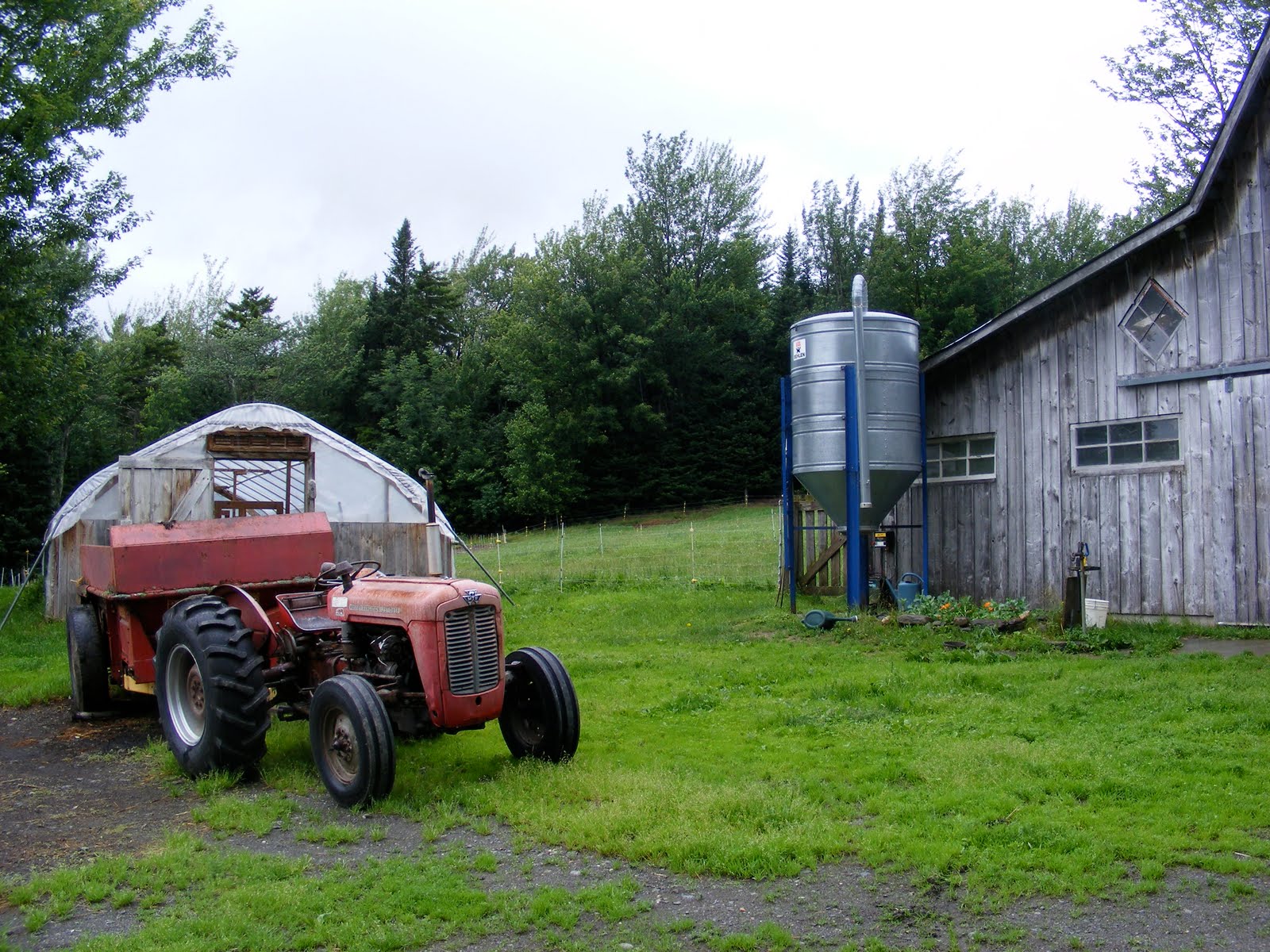
Butterworks is a producer of fine quality yogurts, heavy cream and cheeses widely available throughout Vermont and many of the Eastern states. All of the products except for the cheeses are processed and packaged right here on the farm. Jack attributes his products’ excellent quality and flavor to the protein-rich milk of his Jersey cows. The animals, all born and raised on the farm since 1982, are kept healthy without the use of antibiotics or hormones, and the closed nature of the herd prevents the importation of foreign bacteria and germs. The Lazors chose Jerseys for the high butter-fat content of their milk and their ability to produce milk on a diet composed of at least 80% forage. The remainder of their diet is a mixture of corn, oats, barley, peas and soybeans that are grown organically on the farm and stored in a beautiful new grain silo. The cows spend the winter bedded down in deep clean straw in a large solar barn.


This industrious farm is a “Back to the Land fantasy” come true for the Lazors. Jack is originally from Springfield, Massachusetts. He met his wife Anne at Sturbridge Village in Massachusetts when he was visiting on spring break from the University of Wisconsin. The couple moved to Irasburg, Vermont in 1973 as part of the “Back to the Land” movement of young people from urban to rural areas that was a hallmark of the 1970s. In 1976 they bought the farm just over Lowell Mountain in Westfield and began dairy farming in a way that was good for the health their animals, the environment, and health of themselves and their customers. Jack and Anne chose Vermont’s Northeast Kingdom for its natural beauty and its unique cultural character. They enjoy their proximity to Quebec and the mixture of Quebeçois and transplanted (moved to Vermont from out-of-state) farmers.

According to Jack, Butterworks is the oldest organic dairy farm in the United States, certified since 1984. The farm has been influential in the food economy of the Northeast Kingdom for decades now - many local farmers, including Laini Fondillier of Lazy Lady Goat Farm who we will feature in future weeks, got their start working for the Lazors. Jack is also very active in several local agricultural organizations, including acting as vice president of the Northern Green Growers Association. “Agriculture is not an easy way to make a living, but there’s something wonderful about it,” says Jack. “I think that right now Vermont is so much better than anywhere else in having support for alternative, diversified small business.” He also sees the state as a place where the “independent mindedness” of local farmers and local consumer demand for high quality, socially responsible food is creating a model for small sustainable food economies all over the country. “I see Vermont leading the nation as producers of high quality, organic, value-added food,” he says.


Butterworks Farm’s products have been featured in a number of regional and national publications, including in Martha Stewart Living in 2006. Martha used their yogurt, cream, butter, and cheese in a variety of gourmet desserts and savory dishes. I can tell you from first hand experience that their products are of exceptional quality and flavor. Raw milk directly from the bulk tank is smooth, creamy, and lightly flavored. I also sample a slice of their smoked cheddar, and I think it is on par with the best that Cabot, Vermont and the entire state of Wisconsin have to offer. I ask Jack how he uses Butterworks cheddar in his cooking, and the answer is, of course, “What doesn’t taste better with cheddar?”


Sunday, September 5, 2010

True Love and Homegrown Tomatoes

Homegrown tomatoes, homegrown tomatoes,
What'd life be without homegrown tomatoes?
Only two things that money can't buy-
That's true love and homegrown tomatoes.

-Guy Clark, American songwriter

This week the Northeast Kingdom Farm to Table Project is pleased to once again feature Joe’s Brook Farm of Barnet, Vermont, who will be providing Juniper’s Restaurant with fresh tomatoes and assorted seasonal vegetables.

It is the second week of September, and my garden continues to produce mind-boggling amounts of zucchini. Luckily, the tomatoes are catching up, and their glowing red sweet acidity is a perfect visual and gustatory (word of the day: relating to the sense of taste) complement to cool, green zucchini.

The recipes in this week’s post are inspired by the harvest of my garden, particularly by the sweet cherry tomatoes coming in by the dozen. I’ve included some tomato laden main dishes as well as side-dishes of other seasonal vegetables.

Here's to True Love and Homegrown Tomatoes!

Main Dishes

Salmon Provençal
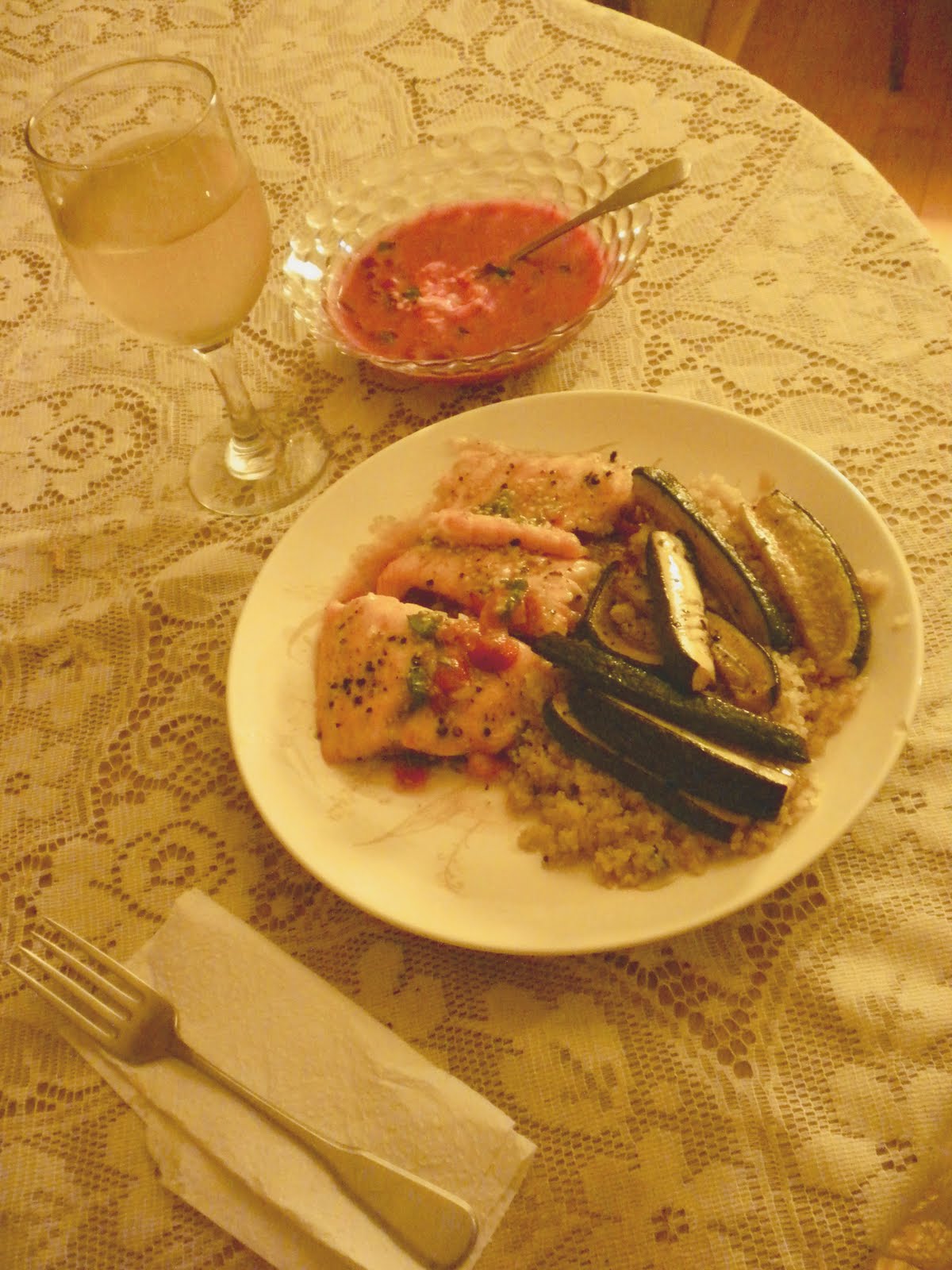
A recipe given to me by my grandmother, I made this seasonal salmon recipe the other night and served it with quinoa pilaf (a tasty and nutritious grain from South America), zucchini spears in a maple-soy marinade, and spicy sweet chilled beet soup.
Yields 4 servings


Sauce
4 cups diced, deseeded tomatoes (any size or variety)
¼-½ cup olive oil
2 tablespoons sherry wine vinegar
½ cup minced shallots
2 cloves minced garlic
2 tablespoons lemon zest
½ cup chopped fresh basil
optional: ¼ cup chopped fresh herbs (thyme, oregano, chives, etc.)
sea salt, black pepper, and cayenne pepper to taste

Salmon
four 6-8 oz. salmon filets
olive oil
sea salt & black pepper to taste
lemon wedges

1. Combine ingredients for the sauce in a medium, non-reactive bowl, three hours to two days ahead of time. Mix well, cover and put in the fridge to marinate.
2. Preheat the oven to broil.
3. Brush the salmon filets with olive oil, add salt and pepper to taste. Place filets skin side down (if using filets with skin) onto an oiled piece of aluminum foil on a baking sheet.
4. Place salmon in the broiler about 5-6 inches under heat. Broil for 7-8 minutes until salmon is firm to the touch and opaque pink in the middle.
5. Spoon a generous amount of the sauce onto individual dinner plates. Place salmon filet on top of sauce, spoon more sauce on top. Serve with lemon wedges


Baked Stuffed Zucchini with Beef, Broccoli & Tomatoes
My mom’s recipe, I made this dish for a Labor Day Weekend potluck. It transports well and tastes great hot or cold. A vegetarian version can be made by substituting spinach, garden vegetables, and/or soft cheese for the hamburger meat. To satisfy the carnivore, replace or augment the sliced tomatoes on top with fried bacon.
Yields 4 servings


2 large (10-12 inches) zucchini

Stuffing Mixture
2 tablespoons olive oil
1 medium onion, chopped
2 cloves garlic, minced
1½ cups chopped fresh seasonal vegetables: I used broccoli and diced cherry tomatoes
¾ lb. ground beef: I used all-natural Belted Galloway beef from Meadowview Farm on Darling Hill
2 tablespoons lemon juice
2 tablespoons fresh chopped parsley
sea salt & black pepper to taste
1 cup quinoa
2 cups water

shredded Vermont cheddar cheese
thinly sliced fresh tomato

1. Preheat the oven to 375 degrees F.
2. Halve zucchini lengthwise. Scoop out seeds to create 4 “zucchini boats”.
3. Poke several holes into the zucchini with a fork. Place onto an oiled baking sheet and bake in the oven for 25 minutes.
4. Heat olive oil on medium heat in a medium-sized saucepan.
5. Cook onions until soft, then add garlic. Sauté until garlic is aromatic.
6. Stir in ground beef, mixing well with the vegetables. Cook thoroughly until brown.
7. Add seasonal vegetables in order of the length of time they take to cook to tenderness: add broccoli just after the onions and before the garlic; add tomatoes after the hamburger has browned.
8. Boil the water in a separate medium saucepan. Stir in quinoa, lower heat to medium. Cook covered for around 15 minutes, until liquid is absorbed and quinoa is fluffy. Stir into stuffing mixture.
9. Fill the zucchini, mounding stuffing slightly above the edge of the “boat”. Top zucchini with cheddar cheese and bake for a further 20 minutes, adding sliced tomatoes on the top for the final 10 minutes.
10. Remove from oven. Sprinkle with fresh parsley and cool for 10 minutes.


Side Dishes

Quinoa Pilaf
Most boxes have easy directions on the side.
Yields 4 servings

2 tablespoons olive oil
½ cup minced onions
1 clove minced garlic
2 cups water or chicken broth
1 cup quinoa
¼ cup fresh chopped parsley
2 tablespoons lemon juice

1. Heat olive oil on medium low heat in a medium-sized saucepan.
2. Cook onions until soft, then add garlic. Sauté until garlic is aromatic.
3. Add water or broth, cover and turn up heat to high to bring water to a boil.
4. Stir in quinoa, lower heat to medium. Cook covered for around 15 minutes, until liquid is absorbed and quinoa is fluffy.
5. Stir in parsley and lemon juice, serve hot or cold.


Zucchini Spears in Maple-Soy Marinade
My own invention.
Yields 4 servings

Sauce
¼ cup pure Vermont maple syrup-what else?
¼ cup low sodium soy sauce
¼ cup olive oil
black pepper to taste

2 medium (8-10 inches) zucchini

1. Combine maple syrup, soy sauce, olive oil, and pepper.
2. Cut zucchini into 4-5 inch spears.
3. Marinate zucchini in sauce for 20 minutes or more.
4. Cook zucchini in your favorite manner: broiled, grilled, or sautéed until cooked through.


Spicy Sweet Chilled Beet Soup
My own invention.
Yields 4 servings

2 cups diced beets (any variety)
1 cup diced red potatoes
8 tablespoons butter
¼ cup pure Vermont Maple syrup
¼ teaspoon cayenne pepper, add more to taste
sea salt & black pepper to taste
4 cups milk
sour cream
¼ cup chopped fresh herbs (basil, oregano, thyme, chives, etc.)

1. Steam beets and potatoes until tender enough to separate with a fork. Mash well.
2. Add butter, maple syrup, cayenne, salt, pepper and milk. Blend well.
3. Chill until cold. Serve with a dollop of sour cream, sprinkle with fresh herbs.


Joe's Brook Farm


The Special
This week we are pleased to feature organically grown tomatoes and assorted seasonal vegetables from Joe’s Brook Farm of Barnet, Vermont. All this week, Chef Casey Graham will use Joe’s Brook Farm products in main dishes, appetizers, soups, and salads. Be sure to ask your server about tonight’s Farm to Table Special!

The Farm
Joe’s Brook Farm is an organic vegetable farm in Barnet, located south of St. Johnsbury in Vermont’s Northeast Kingdom. They are a CSA (Community Supported Agriculture), providing weekly shares of vegetables, eggs and specialty items to 10 local members and they attend weekly farmer’s markets in Lyndonville (Fridays from 3-7pm), St. Johnsbury (Saturdays from 9am-1pm), and Danville (Wednesday mornings). They also provide produce to several local fine restaurants.

www.joesbrookfarm.com


It is good to know and be friendly with your neighbors. The connections you make with the people in your community have a real impact on the quality of daily life, especially when you live in a sparsely populated area like the NEK (Northeast Kingdom). The most important connection you can make when you are trying to be a “localvore” – one who eats only or mostly food that is produced locally - is the one you make with your local farmer. So it is good to have neighbors like Mary Houde-Skovsted and her husband Eric of Joe’s Brook Farm, because they provide members of their community with beautiful, organic vegetables, and keep their land healthy, active, and undeveloped in the tradition of the small family farm. As it turns, out, I am technically a neighbor-once-removed of Mary and Eric, who attended Middlebury college with my real life next-door neighbor. It is a typical kind of connection in this NEK of the woods.

I am visiting Joe’s Brook Farm in Barnet, about 8 miles past St. Johnsbury on Route 5. It is a muggy July morning during this third week of uncharacteristically hot weather here in the Kingdom. At the famous red round barn in Barnet, I make a right on Joe’s Brook Road, pass Brook Hill Road and pull into to the 19th century farmhouse on the left. Across the street sits the barn, sagging back slightly from the road. Eventually the barn will become a farm stand with help from a historic restoration grant from the state. The land drops off sharply behind the barn to the fertile floodplain of Joe’s Brook.


I meet Mary at the farmhouse and we walk behind the barn to the rows of lush vegetables below, discussing our mutual friend and the small world we live in. Mary points out her portable greenhouse, which moves along a rail system that allows it to house cold weather crops like spinach until they can survive outdoors, then moves to shelter warmer weather crops like tomatoes. One of Mary’s neighbors and the former owner of the farm, Stewart Hoyt, stops by looking for plant starters. Stewart is a carpenter and artist, and created the beautiful statue of the man that overlooks Mary’s garden (could this be Joe of Joe’s Brook?). The main greenhouses where Mary grows her tomatoes are on a plot of land that includes the home, sugarhouse and garden of the late Airie Lindsay, one of the founders of the Northeast Organic Farming Association (NOFA). Airie’s daughter and son-in-law now lease the land to Mary and Eric and also donated their tractor and farm truck to the fledgling farmers. It's all about connections.


I am setting up the camera for our interview when Mary comments that these farm visits I’m doing must be starting to blur into each other. I have to admit that in certain ways, yes, they are. Whether they raise animals, vegetables, or make syrup there seem to be only a few reasons why people choose to be natural and organic farmers in northern Vermont: they love the area, they feel strongly about protecting the environment, and they are passionate about good, fresh food and want to share it with others. But how did they get to where they are now? That part of the story is always unique and interesting.

We interrupt this article for a brief Northeast Kingdom moment:
Mary and I are talking and walking through the garden when the frantic barking of her huge dog Maddy brings our attention to the large bull moose who has just arrived in the next field over.

Okay, now we can move on.

Mary is from Barnet and grew up about 2 miles away on a dairy farm, the eleventh of twelve siblings. She met Eric in college. The couple moved to the Northeast Kingdom in 2007 and bought their farm. This year is their first doing a CSA (Community Supported Agriculture), providing weekly shares of vegetables, eggs, and specialty items like maple syrup to 10 local members, and they attend weekly farmer’s markets in Lyndonville, St. Johnsbury, and Danville. Growing up, Mary did not want the life of a dairy farmer, but vegetables had their appeal. “I grew up down the road and my mom always had a big garden, and we always ate out of the garden,” she says. Her early exposure to homegrown food influenced her shopping habits in college and ultimately her views on our national food system and choice of career. “I think everyone should have the chance to buy fresh local food and see what it tastes like, because to me, that’s real food,” she explains.

Since purchasing the farm, Mary has devoted herself full time to the endeavor and has witnessed a surge in the demand for local, organic foods. She is excited to be a part of a community of farmers who are working together to promote the local foods movement. “There are a lot of opportunities for more education,” Mary says. “I think we all realize that we’re not in competition with each other, we’re in competition with Price Chopper and California, the bigger guys, and if we can all just be on the same page, and be friends, and share our techniques, then we can get much further standing together.” Mary is also appreciative of work that the state is doing to promote small vegetable farms. The Vermont NRCS (Natural Resource Conservation Service) is an organization that traditionally provides aid to dairy farms, and they recently began offering an opportunity for local vegetable growers to obtain free large greenhouses. The program stipulates that the greenhouses cannot have heat or electricity, but the structures alone will allow farmers to grow cold weather crops far later in the season.

Joe’s Brook Farm currently grows everything from spinach, broccoli and tomatoes to pak choi, fennel and ground cherries. They will soon offer strawberries, raspberries, and blueberries, and will have maple syrup in the spring. I ask Mary how she is eating her vegetables at the moment. “I like tomatoes raw, with a little balsamic vinegar and olive oil,” she says. “You can’t underestimate good olive oil because that adds a lot to any dish. I’ve been eating a lot of gazpacho in this heat.” Good idea. I drive away with plans to jump in Joe’s Brook, make gazpacho, and visit my nextdoor neighbor to tell her about the new connection I’ve made.

Sunday, August 29, 2010

Shuttleworth Farm

The Special
This week we are pleased to feature country style ribs, bacon, and lamb from Shuttleworth Farm of Westfield, Vermont. All this week, Chef Casey Graham will use naturally-raised Shuttleworth Farm meats in main dishes, appetizers, soups, and salads.

The Farm

Shuttleworth Farm is a family owned and operated farm located in the town of Westfield in the Northeast Kingdom of Vermont. Their sheep, pigs, and poultry are raised on the lush pastures that grow in the shadow of Jay Peak and lie along the banks of the Missisquoi River. Most of the meat from Shuttleworth Farm is sold within two hundred miles of the farm to individual customers as well as fine restaurants and natural food stores.


Shuttleworth Farm

In the green meadows of Westfield at the foot of Jay Peak, a flock of Shuttleworth Farm sheep graze contentedly as clouds engulf the moutain above. The flock is guarded by three border collies and two Great Pyrenées who keep the lambs and ewes from straying too near the banks of the Missiquoi River. This graceful valley is home to Kelli Fogg and Todd Shuttleworth and their daughter Isla, along with a few other small farms and country homes. Shuttleworth Farm is one of the biggest lamb producers in the state of Vermont and part of the growing local foods movement. Most of their lamb, pork, and poultry products are sold within two hundred miles of their property.

I am visiting Kelli and Todd at their farm on a cool morning in June. Isla, their sixteen month old, shows me around the barn, fearlessly toddling up to the dogs and sheep. Like her parents, she seems a born farmer. Todd Shuttleworth has loved family farming since spending his childhood summers on the original Shuttleworth Farm in Canaan, New Hampshire, where his grandparents raised dairy cows and vegetables. “A little bit of nostalgia helps you get involved. It can also help you keep going,” he says.

Todd studied farming at the University of Maryland. After graduation, he moved to the Northeast Kingdom to try his hand at running the family farm. It was in Vermont in 2003 that Todd met Kelli, his real estate agent and a former marketing major at Alfred University. Their shared passion for family farming and naturally raised foods led them to purchase a small flock of sheep and the former dairy farm in Westfield. This new generation of Shuttleworth Farm is a wonderful example of how a combination of responsible farming practices, favorable market trends and modern advertising strategies can support and sustain a small family farm. The Shuttleworths currently have 150-250 ewes, produce up to three hundred lambs a year, and have nine sows.

Nostalgic it may be, but this old-fashioned, low-tech approach to farming in many ways works better and is cheaper, healthier, and more environmentally sustainable than industrialized agriculture. The Shuttleworths have successfully adopted many traditional practices on their farm. They keep their pigs in the Swedish manner, with lots of clean deep straw for bedding and a separate area for their manure. “Pigs are very clean animals, if you give them the choice to be,” Todd observes. His work with the dogs is both nostalgic and effective. “I like to joke that the dogs saved our marriage.” He smiles. “Before we got them it would take us hours to round the sheep up.”

The Shuttleworths are excited about the local food movement and the surge of interest in organic and naturally produced food, though they are realistic about its challenges. “It’s tough. It’s tough for us to get the attention of lawmakers. The dairy industry gets plenty of low interest loans and subsidies,“ Todd says. “Getting a bank to believe in you and your business plan, that’s tough. But I think that as the movement grows, and more people are successful, it’ll get better.”

Another challenge lies in educating consumers about the cost of producing healthy food versus the cost of producing cheap food. Though local and natural foods will often be more expensive, consumers should consider that they are also purchasing reassuring knowledge of where their food is coming from and how it is produced. The cost of producing of cheap foods is more hidden, funded by government subsidies and, ultimately, taxpayers. “I think that consumers can provide some of the most powerful oversight, environmentally and otherwise,” says Todd. “When you have to live in the community where you sell your food, if you were raising a poor product you’d have a bad reputation quick. But when your food comes from God knows where, it’s like this invisible curtain that everything is hidden behind. There’s no real accountability, there’s no liability.”

The purchase of Shuttleworth Farm meats and other locally produced natural foods contributes not only to the growth of strong communities and a safer food system, but also to a healthier environment. “You don’t want to create problems,” Todd says. “We accept responsibility for all of the food we’re producing, everything. All that grain for the animals, all the manure from the animals, that gets handled responsibly.” Their sheep are mostly grass fed, which reduces the use of the fossil fuels it takes to grow and ship grain, and Todd believes the meat is the better for it. “Keeping those animals healthy, and they grow quick on a low or no grain diet, produces a leaner meat, so it’s not greasy,” he says. “You don’t need the mint sauce. It’s very tender.”
.
So of course, one of Todd’s favorite things about sheep farming is the opportunity for quality control. “I love it when a package breaks open and we have to eat it ourselves,” he grins. “I like everything grilled.” Kelli prefers roasting; she says that one of the family’s favorite meals is a boneless rolled lamb shoulder with Montreal steak seasoning, slow roasted in the oven.

The Shuttleworths have a wonderful website and farm blog at www.shuttleworthfarm.com. You can visit their website for information on ordering their products and to learn more about the family and their farming philosophy.


Shuttleworth Farm Mission Statement

People speak about sustainable agriculture as an ideal goal, but at Shuttleworth Farm, we think that sustainability is the least we can do. We are not about maintaining, we are about improving:

* Improving our soils with carefully planned rotations of sheep, laying hens, broilers, turkeys, pigs and hay that perfectly complement the natural growth cycle of our native cool season perennial grasses.
* Improving the health of our animals. Fresh air, sunshine, clean water, and lush green grass benefit all types of livestock, yet so much of modern agriculture denies animals these basic necessities. We let our animals eat and behave as nature intended them to.
* Improving the health of our consumers. Pasture-raised meats are much lower in fat, higher in heart healthy Omega-3 fatty acids and Conjugated Linoleic Acids (CLA's), and excellent sources of Vitamins A, B3, B6, B12, D and E (Jo Robinson, Eat Wild, 2006)
* Improving the health of our community. The average morsel of food in this country travels more than fifteen-hundred miles before it is consumed. (Pollan, Michael. The Omnivore's Dilemma. New York: The Penguin Press, 2006. 239p). We service our local markets. The vast majority of our meats are consumed within two hundred miles of our farm. This permits us to offer quicker time to market, reduced handling charges and huge reduction of the use of fossil fuels.

Sunday, August 22, 2010

Northeast Kingdom Garlic


The Special

This week we are pleased to feature certified organic garlic from Northeast Kingdom Garlic, located in Newport Center, VT. All this week, Chef Casey Graham will use Northeast Kingdom Garlic products in main dishes, appetizers, soups, and salads. Be sure to ask your server about tonight’s Farm to Table Special!

The Farm
Northeast Kingdom Garlic is a certified organic garlic farm located in Newport Center, VT in the shadow of Jay Peak on Clark Mountain Road. Northeast Kingdom Garlic sells most of its product to local Vermont customers in addition to clients as far as Boston, MA. Northeast Kingdom Garlic is a registered trademark and a member of the Garlic Seed Foundation of Rose, NY.

A Tribute to Garlic

Garlic, all powerful
marvelous seasoning,
you are the essence,
the incense which
revives and exhilarates.
You are the spur that
excites, stimulates.
Garlic, you stir up,
you impel, you cheer;
you are the only
condiment, you are
the glorious one,
the sovereign extract
of the Earth.

-G. Coquiot

Mr. Coquiot obviously really liked garlic. We really like garlic, too, here at Juniper’s Restaurant at the Wildflower Inn. So does Zachary Hart of Northeast Kingdom Garlic in Newport Center, Vermont. He has been raising organic garlic for six years, and this week we are pleased to feature it in a variety of our regular and special offerings.

I saw Mr. Coquiot’s poem hanging on the wall in Zack’s off-the-grid homestead, and thought that it spoke beautifully and passionately about the endless possibilities of garlic. “It’s almost hard to find a recipe that doesn’t use garlic,” Zack points out. "It’s almost like a spice or a condiment. I use it in everything, aside from maybe dessert.” He is working to create a local source for this most essential of bulbs in northern Vermont.


Zack is a native of Coventry, Vermont and a 1997 graduate of North Country High School in Newport. He attended college in Boston and Syracuse, New York, obtaining a degree in environmental and forest biology. Zack returned to the Northeast Kingdom several years ago after spending time in various other parts of the country, including in Alaska where he worked for one of the premier birch syrup producers in the state. An opportunity to work full-time for Landvest, a real estate company in Newport where he is a field forester specializing in GIS (digital mapping) technology, brought Zack back to his home turf.

Northeast Kingdom Garlic is a side endeavor, though it is nearly is a full-time job in itself. Zack currently raises around 600 pounds of certified organic music garlic (a popular variety from Germany) per year, and he would like to increase that number in the future. He also keeps bees (Z’s Bees) and raises chickens and vegetables for his own consumption. Zack and his single employee/accomplice, his partner Emily Dehoff, will sell most of their garlic this year to local Vermont customers in addition to clients as far as Boston.


Most garlic used in Vermont is imported from places like China, Mexico, and Argentina. Zack thinks it makes more sense to create a reliable local source for this crop that grows so well in Vermont’s cool climate. “I want to be the go-to garlic guy,” he says. He sees great potential for Vermonters to grow and distribute many crops locally, and his foray into garlic farming is a response to local demand for naturally produced food. “I think Vermont is lucky in that we already have a strong agricultural base intact,” he says. “People want to know where their food is coming from, and that knowledge is hard to put a price on. I’ve always farmed naturally. It makes sense for our health and the health of the soil.”

“I got into garlic because I love to cook,” Zack says. “It is a great crop. Good for the circulatory system, immune system boosting, and a natural antibiotic.” He is hard-pressed to choose a favorite way of preparing his garlic, but stresses that, “The most important thing you can do is to get a good garlic press.”

nekgarlic[at]gmail.com